

Buying Property in Japan: 7 Things to Check Before You Make an Offer
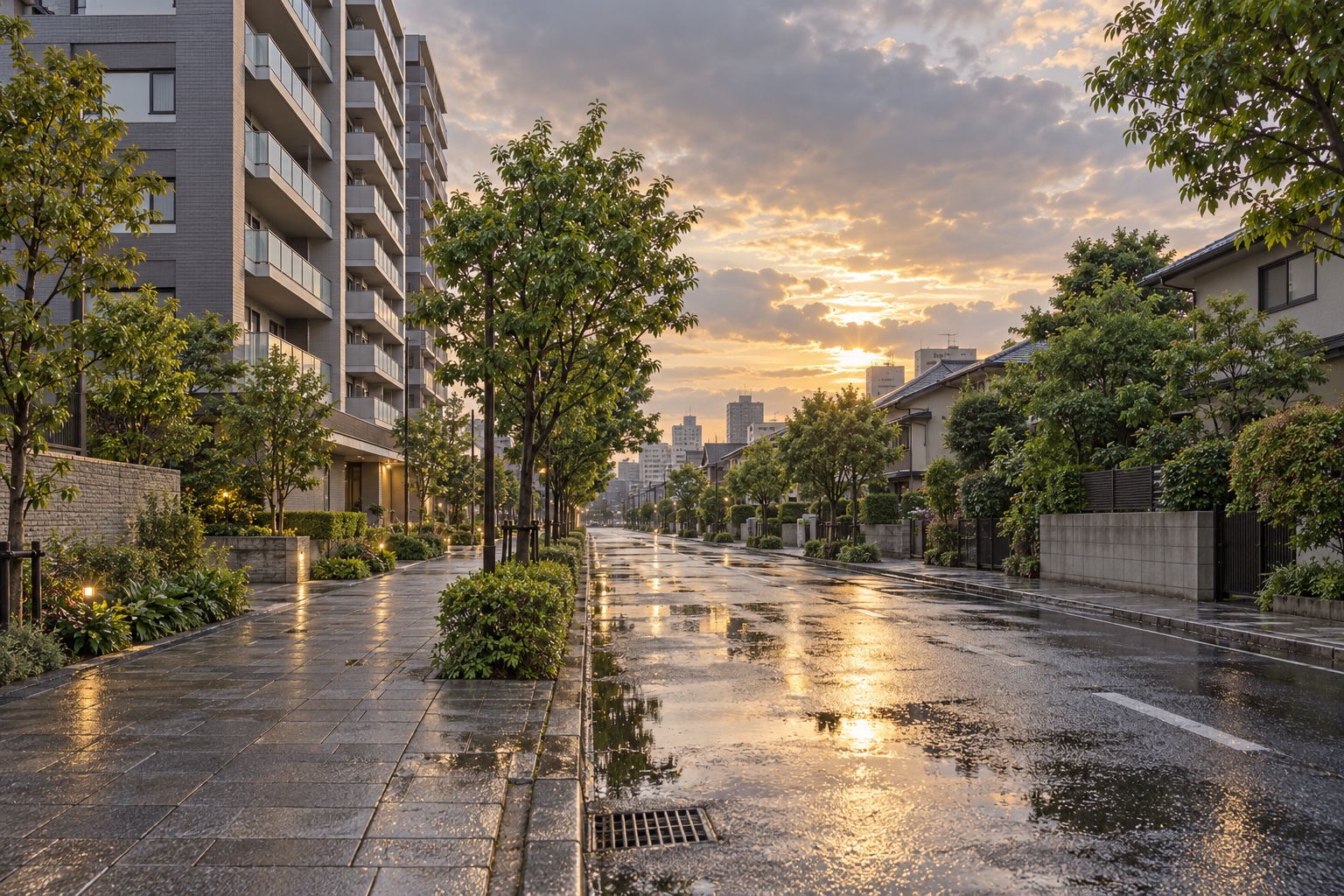
Before you make an offer on a home in Japan, 7 things deserve a clear answer, and most of them concern how the deal is run rather than the unit itself: the agent's role and fee, whether the management fee and repair reserve may rise, how to make up for not viewing in person, how long a resale could take, the disaster risk at the address, which language version of the documents counts, and whom to ask about tax, residence status and remittances. For each of the 7, this article sets out what to know first and whom to ask (information as of September 17, 2026). Buying in Japan calls for care, and that care should cover these details of the transaction as well as the home itself.
At a glance: the 7 things and whom to ask
| Item | What to know first | Whom to ask |
|---|---|---|
| The agent | Ads show whether the company is the seller, an authorized agent or a broker; the brokerage fee has a legal ceiling | The real estate company handling the deal in Japan |
| Management fee and repair reserve | The amounts at the time you buy are not necessarily fixed | Your agent (ask the seller's side for the management records) |
| Buying without viewing | Remote checks can cover part of a viewing, not all of it | Your agent; an architect who carries out building condition surveys |
| Selling later | A sale takes time, and how long varies with area, building age and management | Your agent (closed sales in the same building and nearby) |
| Disaster risk | You can look up flooding and other risks by address; check earthquake-related points separately | Check yourself first, then ask your agent to explain |
| Language and documents | Japan's Ministry of Land, Infrastructure, Transport and Tourism (MLIT) recommends that companies agree with clients that the Japanese text is the original, with translations as reference | Your agent, an interpreter, and professionals such as a judicial scrivener |
| Tax, residence status and remittances | This article does not explain them | A licensed tax accountant, an immigration specialist, your bank |
The agent: know their role and how the fee works
Read the "transaction type" in the ad. A Japanese property ad states whether the company placing it is the seller (urinushi), an authorized agent (dairi) or a broker (baikai, also called chūkai). This is the torihiki taiyō, or "transaction type." Fudosan Japan, the consumer site of the Real Estate Transaction Promotion Center, explains that whether a brokerage fee is payable is related to the transaction type, and the National Federation of Real Estate Fair Trade Councils' handbook explains that when the transaction type in the ad is brokerage, you pay the brokerage fee (baikai hōshū) to the brokering company.[1] If you engage an agent yourself, confirm when you engage them under what conditions their fee becomes payable and how much it is.
The fee has a ceiling, and the ceiling is not the default. Under the Building Lots and Buildings Transaction Business Act (takuchi tatemono torihiki gyōhō), the fee a real estate company may receive is set by a notice issued by the Minister of Land, Infrastructure, Transport and Tourism, and the company may not exceed it. Fudosan Japan points out that the law sets an upper limit; it does not mean a company is automatically entitled to charge that limit.[2] This article does not give amounts or the formula. Before you engage an agent, ask them to explain how the fee for this transaction is calculated and when it is paid.
You can look up a company's license. According to Fudosan Japan, a company that carries out real estate sales or brokerage in Japan as a business needs a license for the building lots and buildings transaction business (referred to below as a takken license).[3] With MLIT's Construction and Real Estate Business Information Search System, you can search by company name to see whether a company holds a takken license, who its representative is, where it is located, and whether the license was issued by the Minister of Land, Infrastructure, Transport and Tourism or by a prefectural governor.[4] The figure in brackets in a license number is the number of times the license has been renewed plus 1. Since the license is renewed every 5 years, a larger figure means more years have passed since the company obtained its license. Fudosan Japan also notes that this is only a reference point when choosing a company: a company with few renewals may still have plenty of experience.[5]
When an ordinary buyer purchases through a real estate company, there is an explanation of important matters before the contract. Before the sales contract is concluded, the company must have a Real Estate Transaction Specialist (takuchi tatemono torihikishi, "specialist" below) hand you a document setting out the important matters, bearing the specialist's name, and explain it to you orally. This is the jūyō jikō setsumei.[6] Where the conditions are met, this document can also be provided electronically (see "Buying without viewing" below). The contact you first speak to in your own country and the company in Japan that actually handles the deal and gives this explanation may not be the same company, so confirm which one it is.
Whom to ask: your agent. Ask what the transaction type is, how the fee is calculated and when it is paid, and which company's Real Estate Transaction Specialist will give the explanation of important matters. You can also check what the agent tells you against another real estate company or third parties such as a tax accountant or an architect.
Management fee and repair reserve: the amount may not stay the same
When you buy a unit in a Japanese condominium, you normally pay, on top of the purchase price, a monthly management fee (kanrihi) and a monthly repair reserve contribution (shūzen tsumitatekin, money saved for planned future repairs to the exterior walls, roof and so on). The building is managed by an owners' association (kanri kumiai) made up of the people who own its units.[7] The amounts you see on a listing are today's figures, and they may change.
They may rise after the plan is reviewed. MLIT's guidelines on repair reserve funds state that even under the "equal accumulation method" (kintō tsumitate hōshiki, saving evenly from the start), contributions may need to rise when the long-term repair plan is reviewed. They also recommend that, whatever the saving method, the plan be reviewed regularly (about every 5 years) and the repair reserve amount reset on that basis. The guidelines also note cases where, under a method that starts low and raises contributions in steps, owners could not reach agreement when an increase was due, leaving the repair reserve short.[8]
For a resale unit, you can request the records first. MLIT's handbook for buyers explains that you can ask the seller's side, through the agent, to provide the building's management information, and its checklist includes whether any change to the management fee and repair reserve is planned and how large the planned increase is. Some buildings, however, can disclose only limited information.[9]
Whom to ask: your agent. Ask for the long-term repair plan, the minutes of recent general meetings, and any planned changes to the management fee and repair reserve.
Buying without viewing: what remote checks can and cannot cover
If you live outside Japan, flying in several times to see one home is not easy. Fudosan Japan's advice on viewings suggests looking at the surroundings at different times of day and on both weekdays and weekends, and notes that a rainy day shows where drainage is poor.[10] When you cannot go yourself, asking the agent for photos or video taken at different times fills part of the gap, but photos and video cannot give you a complete picture of what the site is like.
The explanation of important matters can also be given online. MLIT began full operation of online explanations of important matters for sales (IT jūsetsu) on March 30, 2021, and from May 18, 2022, the explanation document, the documents issued at contract and similar papers can also be provided electronically. These are two separate systems. Each can be used only when the prescribed conditions are met and the consent of the other party (that is, the parties to the transaction, including the buyer) has been obtained, and you can still choose a face-to-face explanation and paper documents.[11]
A professional can check the building's condition. For a resale home, you can ask your agent whether a building condition survey (tatemono jōkyō chōsa, often called an "inspection") can be carried out: an architect who has completed a course run by a body registered with the Japanese government examines the main structural parts and the parts that keep rainwater out, by visual checks, measurement and similar methods. The result does not mean the home is free of every defect, and if the buyer arranges the survey, the seller's consent is needed first.[12]
Whom to ask: your agent. Ask whether a video viewing is possible, whether extra photos or video can be taken at different times, and whether a building condition survey can be done.
Selling later: a sale takes time
Before you buy, think about how you would sell.
Days to a closed sale. REINS is a property search system used among Japan's real estate companies: once a company that has been asked to broker a property registers it, other companies can see it too.[13] According to statistics from the East Japan Real Estate Information Network, resale condos that sold in Greater Tokyo (Tokyo, Kanagawa, Saitama and Chiba) in 2025 took 82.5 days from registration on REINS to a closed sale (calendar year 2025).[14] The figure counts only units that sold; units that did not sell or were withdrawn are not included.
Population and vacant homes. According to the preliminary figures from Japan's population census, the population on October 1, 2025 was 123.05 million, down 3.097 million (2.5%) from 2020.[15] On October 1, 2023, Japan had 9.002 million vacant homes, a vacancy rate of 13.8%. These figures include homes held for rent or for sale, and cover detached houses and rental apartments as well, not condominium units alone.[16]
These are national or Greater Tokyo totals and say nothing about how easily a particular property will sell; when you look at a particular property, compare its area, building age and management as well. If you measure your purchase cost and sale proceeds in your home currency, the timing of the exchange and the exchange rate also affect the converted result.
Whom to ask: your agent. Ask for closed-sale records for the same building or for nearby buildings of similar age, and how long those properties took from going on sale to closing (this is a different measure from the REINS "registration to closed sale" figure above).
Disaster risk: look up the address before you make an offer
Check it yourself first. The Hazard Map Portal Site, run by MLIT and the Geospatial Information Authority of Japan, has two parts. The Kasaneru Hazard Map ("overlay hazard map") layers risk information on flooding, sediment-related disasters (such as debris flows and slope failures), storm surges, tsunami and more on one map, and you can enter an address to check that location; the Wagamachi Hazard Map ("my town hazard map") links to the hazard maps made by each municipality.[17] The site is in Japanese only; MLIT's Disaster Prevention Portal has a Traditional Chinese version, which links to the site.[18]
For evacuation and for flood hazard maps under the Flood Control Act, use the municipality's version. The site explains that the Kasaneru Hazard Map shows disaster risk information prepared by national, prefectural and other bodies, and is not the flood hazard map that municipalities prepare under the Flood Control Act; for an actual evacuation, it directs you to the municipality's map.[19]
It also appears in the explanation of important matters. From August 28, 2020, the explanation of important matters in Japanese property transactions has included where the property lies on the flood hazard map prepared under the Flood Control Act. MLIT's guidelines also ask companies to take care that the other party does not wrongly conclude there is no flood risk just because the property lies outside an expected inundation area.[20]
Check earthquake-related points separately. Fudosan Japan notes that even a solidly built building may lose its utilities if the surrounding ground is soft, so you should look up disaster preparedness information for the area you are considering. MLIT's checklist for buyers also lists the building's completion year as an item to check, as a rough guide to whether it was built before the new seismic standards (shin-taishin kijun) applied.[21] The completion year is only a starting point; ask your agent or an architect which seismic standards apply to the building and what related documents exist.
Whom to ask: first look up the address yourself, then ask your agent to explain where the property lies on the municipality's maps, the completion year and any seismic-related documents, and what disaster preparations the owners' association has in place.
Language and documents: confirm which version counts
MLIT's recommendation. MLIT's 2017 practical manual for real estate companies dealing with international clients, in the context of recommending that contracts name a Japanese court as the agreed court of jurisdiction, also recommends that companies agree with clients that the Japanese text is the original for documents such as the brokerage contract, the explanation of important matters and the sales contract; where a translation is possible, handing it over as a reference translation helps the client understand.[22] This is a recommendation to companies, not a legal requirement. If you receive a Chinese or English translation, confirm with your agent before signing which version counts.
Floor area is measured differently. In Japanese ads, floor area is as a rule measured to the centerlines of the walls (kabeshin), and the balcony is not included; for resale condos, however, an ad may show the registered area, measured to the inner faces of the walls (uchinori). Under Taiwan's standard contract for the sale of existing homes, by contrast, the scope of the sale includes the buyer's share of the common parts (what Taiwanese buyers call gongshe). The two cannot be compared directly, so ask your agent which method the area shown uses.[23]
Whom to ask: your agent. Ask whether a reference translation is available, whether the explanation of important matters document can be sent ahead so you can read it first, and whether an interpreter can be arranged for the explanation. For the certificates needed for registration, ask the judicial scrivener (shihō shoshi) handling the registration.
Tax, residence status and remittances: ask a professional directly
Tax: names only. The main taxes that may apply are: on acquisition, real estate acquisition tax (fudōsan shutokuzei), registration and license tax (tōroku menkyozei, on registration) and stamp duty (inshizei, on the sales contract and similar documents); while you own the property, fixed asset tax (kotei shisanzei) and city planning tax (toshi keikakuzei, which some municipalities do not levy); when you sell, income tax on capital gains from the transfer (jōto shotoku, income from selling property and similar assets).[24] Whether each one applies, the amounts and how they are calculated depend on the property and your personal circumstances; this article does not cover them, so check with a Japanese licensed tax accountant (zeirishi).
Residence status: a separate procedure. Buying property in Japan and obtaining residence status are separate procedures. For questions about residence status, ask the Immigration Services Agency of Japan or a specialist who handles immigration applications; this article does not explain residence status.[25]
Remittances and reporting. The route and timing of a transfer from overseas, how exchange-rate movements affect the payment, and whether a report to the Japanese government is needed after the purchase: check these with your agent, your bank and professionals before you make an offer. Whether you need to report anything in your home country, ask an accountant and bank there.
Avoiding regret: situations that change how much each item matters
- If you can visit the site yourself several times, or read Japanese or have an interpreter: the viewing and language items weigh less.
- If you have no plans to sell in the short term: resale weighs less, but the longer you hold the property, the more important it is to understand in advance how the repair reserve may be adjusted.
- If the expected flooding is deep, the management records are not available, or the transaction type and fee are not clearly explained: even if you love the home, that can be a reason to pause or reconsider.
This is the editors' summary; it does not address future price movements or investment results.
Take this list with you when you look at properties
You can start by browsing the Japanese properties currently listed on our site. When a property interests you, turn the "Whom to ask" notes at the end of each section into questions and send them to the agent before you make an offer.
Sources
- 不動産広告の見方(基本編) (How to read property advertisements: basics) (Real Estate Transaction Promotion Center, "Fudosan Japan"); 住まいを選ぶ前に知っておきたい 不動産広告の読み方・見方 (How to read property advertisements before choosing a home) (National Federation of Real Estate Fair Trade Councils)
- <消費者の皆様向け>不動産取引に関するお知らせ (Notices on real estate transactions for consumers) (MLIT); 宅地建物取引業法 第46条 (Building Lots and Buildings Transaction Business Act, Article 46) (e-Gov Laws and Regulations Search); 仲介手数料について (About brokerage fees) (Real Estate Transaction Promotion Center, "Fudosan Japan")
- 不動産会社について調べる (Checking a real estate company) (Real Estate Transaction Promotion Center, "Fudosan Japan")
- <消費者の皆様向け>不動産取引に関するお知らせ (Notices on real estate transactions for consumers) (MLIT); 建設業者・宅建業者等企業情報検索システム (Construction and Real Estate Business Information Search System) (MLIT)
- 宅地建物取引業法の解釈・運用の考え方 (Interpretation and operation of the Building Lots and Buildings Transaction Business Act) (MLIT, version in force from April 1, 2026), notes on Article 6; 不動産会社について調べる (Checking a real estate company) (Real Estate Transaction Promotion Center, "Fudosan Japan")
- 重要事項説明のチェックポイント (Checkpoints for the explanation of important matters) (Real Estate Transaction Promotion Center, "Fudosan Japan"); 宅地建物取引業法 第35条 (Building Lots and Buildings Transaction Business Act, Article 35) (e-Gov Laws and Regulations Search)
- マンションの修繕積立金に関するガイドライン (Guidelines on repair reserve funds for condominiums) (MLIT, revised June 2024); 快適なマンションライフのはじまりは…マンションの管理を知ることから! (A comfortable condo life starts with understanding how the building is managed) (MLIT, March 2025)
- マンションの修繕積立金に関するガイドライン (Guidelines on repair reserve funds for condominiums) (MLIT, revised June 2024)
- 快適なマンションライフのはじまりは…マンションの管理を知ることから! (A comfortable condo life starts with understanding how the building is managed) (MLIT, March 2025)
- 現地見学時のチェックポイント (Checkpoints when viewing a property) (Real Estate Transaction Promotion Center, "Fudosan Japan")
- IT重説の本格運用について (Full operation of online explanations of important matters) (MLIT, March 30, 2021); 不動産取引時の書面が電子書面で提供できるようになります (Documents in property transactions can now be provided electronically) (MLIT, April 27, 2022); ITを活用した重要事項説明 実施マニュアル (Manual for explanations of important matters using IT) (MLIT, December 2024); オンラインでの不動産取引について (About online property transactions) (MLIT)
- 建物状況調査(インスペクション)活用の手引き (Guide to using building condition surveys (inspections)) (MLIT, April 2024)
- <消費者の皆様向け>不動産取引に関するお知らせ:「レインズ」(REINS)とは (Notices on real estate transactions for consumers: what is REINS?) (MLIT)
- 首都圏不動産流通市場の動向(2025年) (Trends in the Greater Tokyo real estate market, 2025) (East Japan Real Estate Information Network (REINS), January 20, 2026)
- 令和7年国勢調査 人口速報集計 結果の要約 (2025 Population Census, preliminary counts: summary of results) (Statistics Bureau of Japan, Ministry of Internal Affairs and Communications, May 29, 2026)
- 令和5年住宅・土地統計調査 住宅及び世帯に関する基本集計 結果の概要 (2023 Housing and Land Survey, basic tabulation on dwellings and households: summary of results) (Statistics Bureau of Japan, Ministry of Internal Affairs and Communications, September 25, 2024)
- ハザードマップポータルサイトを活用して災害に備えよう (Prepare for disasters with the Hazard Map Portal Site) (MLIT and Geospatial Information Authority of Japan, June 5, 2025); ハザードマップポータルサイト (Hazard Map Portal Site)
- 防災入口網站(繁體中文) (Disaster Prevention Portal, Traditional Chinese) (MLIT)
- ハザードマップポータルサイト よくある質問 (Hazard Map Portal Site: frequently asked questions); 新機能の説明 (Explanation of new features) (MLIT and Geospatial Information Authority of Japan)
- 不動産取引時において、水害ハザードマップにおける対象物件の所在地の説明を義務化 (Explaining a property's location on the flood hazard map made mandatory in property transactions) (MLIT, July 17, 2020)
- 現地見学時のチェックポイント (Checkpoints when viewing a property) (Real Estate Transaction Promotion Center, "Fudosan Japan"); 快適なマンションライフのはじまりは…マンションの管理を知ることから! (A comfortable condo life starts with understanding how the building is managed) (MLIT, March 2025)
- 不動産事業者のための国際対応実務マニュアル (Practical manual on international clients for real estate companies) (MLIT, August 2017)
- 住まいを選ぶ前に知っておきたい 不動産広告の読み方・見方 (How to read property advertisements before choosing a home) (National Federation of Real Estate Fair Trade Councils); 不動産広告の見方(基本編) (How to read property advertisements: basics) (Real Estate Transaction Promotion Center, "Fudosan Japan"); 成屋買賣定型化契約應記載及不得記載事項 (Required and prohibited terms for standard contracts for the sale of existing homes) (Ministry of the Interior, Taiwan)
- 不動産取得税 (Real estate acquisition tax), 固定資産税 (Fixed asset tax), 都市計画税 (City planning tax) (Ministry of Internal Affairs and Communications); 登録免許税の税額表 (Registration and license tax rate table), 印紙税額の一覧表 (Stamp duty table), 譲渡所得(土地や建物を譲渡したとき) (Capital gains on transfer: when you sell land or buildings) (National Tax Agency)
- 在留資格から探す (Search by status of residence) (Immigration Services Agency of Japan)
Related articles
 Topics
SORA Forms a Business Alliance with Baashir Advisory Group in Hong Kong
SORA Co., Ltd., the operator of realestatejapan.jp, has entered into a business alliance with Baashir…
October 6, 2026
 Guide
GuideBefore You Buy a ¥100 Million Condo in Japan: Documents to Request
Before you make an offer on a resale condominium in Japan, ask your agent for four documents: the management…
October 6, 2026
 Guide
GuideOkinawa Property for Sale: Prices, Naha Condos and Seaside Homes
How much does property cost in Okinawa? As of September 10, 2026, the latest figures from West Japan REINS,…
September 10, 2026