

Okinawa Property for Sale: Prices, Naha Condos and Seaside Homes
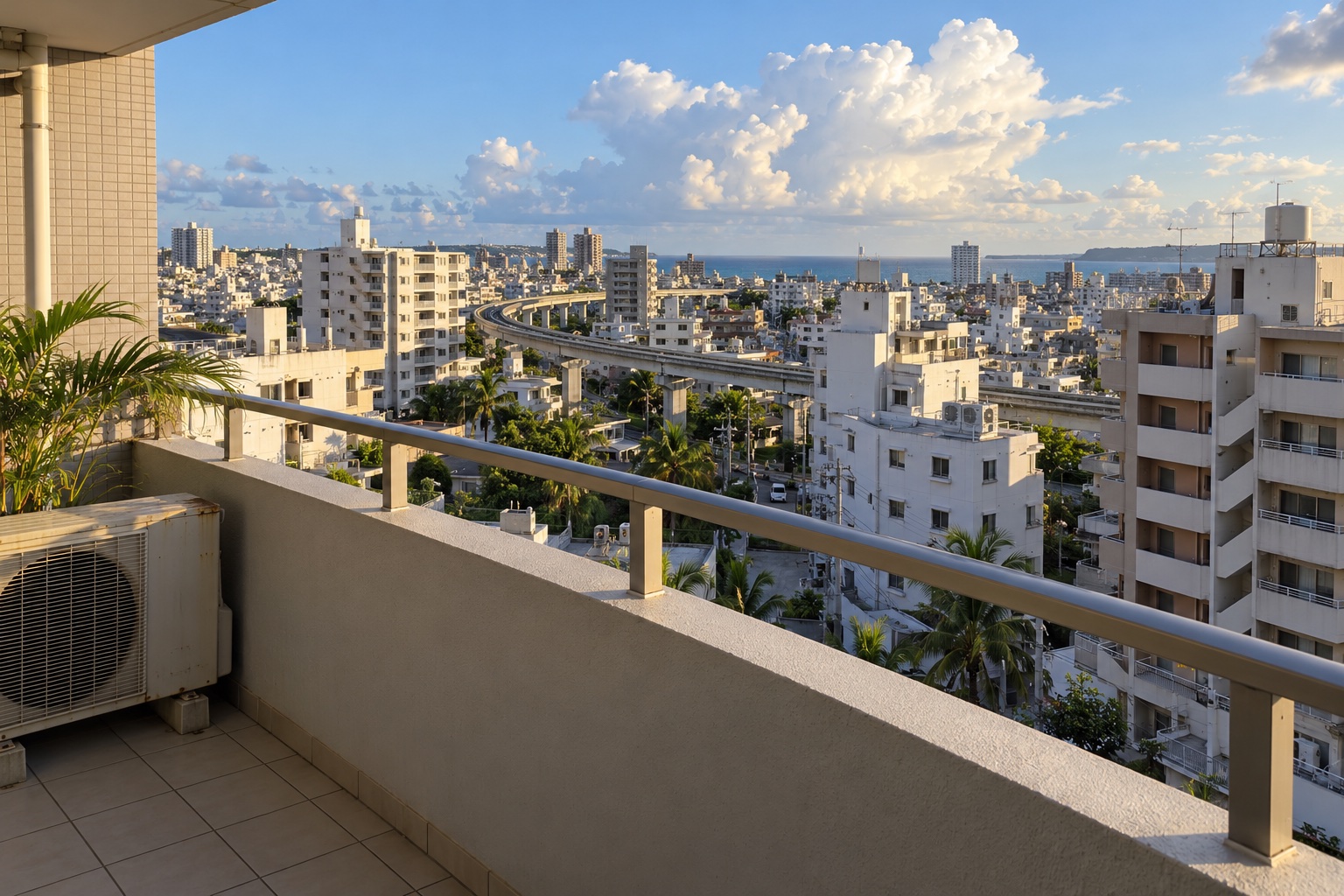
How much does property cost in Okinawa? As of September 10, 2026, the latest figures from West Japan REINS, the sales database that Japanese brokers share, put the average resale condominium in Okinawa Prefecture at ¥36.67 million (91 sales) and the average resale house at ¥41.09 million (48 sales) for the April–June quarter of 2026, a moving average of the latest two quarters; both are prefecture-wide averages that do not separate Naha from the coast. Land is measured separately: in the 2026 Land Price Publication, residential land in Naha averaged ¥216,000 per m², and across the prefecture's residential sites surveyed in both years, prices rose 6.4% on average, a smaller rise than the previous year's 7.3%.
Price is one side of the choice between a condo in Naha and a house by the sea. The other side is what the distance from the water brings with it (salt, storm surge, tsunami) and who looks after the home in typhoon season while you are away. Check both before you make an offer. All figures below come from data published on or before that date.
How much does property cost in Okinawa: sale prices, land prices and new condos
What resale homes sold for. West Japan REINS (the Nishi-Nihon Real Estate Distribution Organization) compiles the sales recorded in REINS, the property database shared by Japanese brokers. Its figures for the April–June quarter of 2026, sale counts included, are a moving average of the latest two quarters, and they cover condominium units with under 350 m² of floor space and houses on 50 m² or more but under 500 m² of land. For resale condominium units in Okinawa Prefecture (called "mansion" in Japan), it counted 91 sales at an average of ¥532,000 per m² and an average price of ¥36.67 million, up 2.5% on the same quarter a year earlier; the average unit had 68.9 m² of floor space and was 19.9 years old.[1] Resale detached houses: 48 sales at an average price of ¥41.09 million, down 0.5% year on year, with an average of 198.1 m² of land, 114.2 m² of floor space and a building age of 22.7 years.[2] Across the whole prefecture, resale sales in a quarter run to a few dozen, and the report itself does not chart Okinawa condominiums because some quarters have few sales. These are past sales, not a forecast.
What land is worth: the Land Price Publication. The Land Price Publication (Chika Koji) is a survey in which Japan's Ministry of Land, Infrastructure, Transport and Tourism (MLIT) publishes the prices of standard sites as of January 1 each year. In 2026 the average annual change for residential land in Okinawa Prefecture was +6.4% (previous year: +7.3%) and for commercial land +7.3%, against +2.1% for residential land nationwide.[3] The changes are calculated only from sites surveyed in both years. Residential land in Naha averaged ¥216,000 per m², with an annual change of +5.3%.[4] That average is a simple average of the survey sites and moves with the mix of sites; it is a price for land, not for a home.
The real estate appraisers in charge of Okinawa wrote in the same year's analysis that land rose in all 21 municipalities and housing demand stayed strong across the prefecture, but that the prefecture-wide rise had narrowed slightly and that land prices in some areas were starting to look as if they had peaked. They named three main factors: the spread of newly built wooden houses sold ready-built (though with a sense of oversupply and asking prices staying high, sales of these have begun to weaken), demand for housing in Naha spilling over into surrounding areas, and people from inside and outside the prefecture moving to, or buying second homes in, resort-style areas such as some outlying islands and the coasts of central, southern and northern Okinawa Island.[5] Among the residential standard sites in the 2026 Land Price Publication, the highest-priced in the prefecture was in Omoromachi 3-chome, Naha, at ¥452,000 per m². The analysis describes demand there from individual investors outside the prefecture for investment condominiums as steady, but also notes that sales had begun to slow somewhat.[6]
A second land survey: the Prefectural Land Price Survey. The Prefectural Land Price Survey (Chika Chosa) is a similar survey that each prefecture carries out with July 1 as its reference date. According to MLIT's summary of the 2025 results, Okinawa was the prefecture with the highest change for residential land (+5.7%), and residential land in the prefecture averaged ¥74,900 per m².[7] The table lists Naha, discussed in this article, and the coastal and island areas featured in the prefecture's area guide.[8]
| Municipality | Average residential land price (yen per m²) | Survey sites |
|---|---|---|
| Naha City | 244,100 | 18 |
| Chatan Town | 145,800 | 5 |
| Ishigaki City | 39,700 | 6 |
| Onna Village | 38,200 | 5 |
| Miyakojima City | 22,500 | 11 |
The two land surveys use different sites and different reference dates, so their average prices cannot be compared directly. Where a municipality has a handful of survey sites, the average does not tell you what sea-view plots or a particular property cost.
New and 10-year-old condominiums. Tokyo Kantei, a private research firm, converts condominium prices to a 70 m² unit so that areas can be compared. For 2024, a new condominium in Okinawa Prefecture came to ¥52.41 million, 12.66 times the estimated average annual income of the prefecture's residents (national average: 10.38 times). A 10-year-old resale condominium came to ¥46.33 million, or 11.19 times (national average: 7.55 times).[9] This multiple is called the price-to-income ratio. The figures are converted prices, not the actual transaction prices of individual properties.
Condominiums in central Naha
Along the monorail. The Yui Rail monorail runs from Naha Airport Station to Tedako-Uranishi Station: 19 stations over 17 km, about 37 minutes one way end to end. It opened between Naha Airport and Shuri on August 10, 2003, and was extended to Tedako-Uranishi on October 1, 2019.[10] If a property is some way from a station, check how you would get around day to day and whether parking comes with it.
Naha Shintoshin (Omoromachi). This district was once the US military's Makiminato Housing Area. After the land was fully returned in 1987, it was rebuilt as a new town through land readjustment, and completion of the readjustment was formally announced in January 2005.[11] The prefecture's highest-priced residential standard site in the Land Price Publication, mentioned above, is also in Omoromachi.[6]
Population. Preliminary figures from Japan's 2025 census put Okinawa Prefecture's population at 1,468,220, up 0.1% from 2020. Naha had 311,073 people, down 2.1%, the largest fall in number of any municipality in the prefecture. Over the same period, the number of households in Naha rose 4.8%.[12]
Seaside homes: salt stays on the building
More than nine in ten occupied homes in Okinawa are not wooden. In Japan's 2023 Housing and Land Survey, 96.5% of occupied homes in Okinawa Prefecture were non-wooden (46.0% nationwide), and 93.8% of all occupied homes were built of reinforced concrete or steel-reinforced concrete. The same survey also found that the number of wooden homes in Okinawa had risen for the first time since the survey began in 1973.[13] When you look at a house by the sea, check whether it is concrete or timber.
Salt. A 2009 document from Japan's National Institute for Land and Infrastructure Management (NILIM) cites the salt-damage zones in the Specifications for Highway Bridges then in force: the whole of Okinawa Prefecture is in Area A, where land up to 100 m from the coastline falls in countermeasure class S, and land over 100 m and up to 300 m in class I.[14] This is a bridge standard (the specifications have since been revised), not a rule for housing. A corrosion-protection manual for steel bridges, supervised by the Okinawa General Bureau and Okinawa Prefecture, also describes Okinawa as a region that typhoons pass through often, with large amounts of airborne sea-salt particles that speed up the corrosion of steel.[15] The Building Research Institute placed reinforced concrete structures and test pieces in a salt-laden environment in northern Okinawa; a survey 14 years later found corroded reinforcing bars and spalling concrete in parts whose surfaces had not been treated, while the treated parts showed no deterioration. That is the result of a test, not a picture of homes on the market, but it shows that surface treatment and upkeep are worth checking.[16]
When you look at a seaside property, ask the agent to check:
- How far it is from the coastline, and whether the sea-facing walls show cracks, rust stains or spalling concrete
- Rust on railings, window frames, metal gates and other metal parts, and on air-conditioner outdoor units
- Records of past exterior painting and waterproofing, and when the next repairs are planned
- For a condominium, whether salt-damage repairs are included in the long-term repair plan
- The building's seismic design and past inspection records
Location checks: flood risk and aircraft noise
Tsunami and flooding. In March 2015 Okinawa Prefecture set and published projections of the areas that a tsunami could flood. They assume the largest class of tsunami striking under adverse conditions, and places outside the projected areas can still flood. To see the possible flooding for a given address, use the Geospatial Information Authority of Japan's "Kasaneru Hazard Map", which overlays different hazards on one map; Naha City also publishes hazard maps for river flooding, inland flooding and storm surge.[17]
Noise zones near the bases. According to Okinawa Prefecture, US military facilities and areas (including those for exclusive and temporary use) occupy 8.2% of the prefecture's land area and 14.6% of Okinawa Island (as of January 1, 2025).[18] Around Kadena Air Base and Futenma Air Station there are Class 1 zones, areas that Japan's Ministry of Defense designates because of aircraft noise, and the Okinawa Defense Bureau publishes reference maps of them.[19] For a property in central Okinawa Island, ask the Okinawa Defense Bureau whether it lies inside a zone.
Naha's climate and typhoons
Naha's climate normals (the 30-year average for 1991–2020) are a mean annual temperature of 23.3°C, mean relative humidity of 73% and annual rainfall of 2161.0 mm.[20]
On the Japan Meteorological Agency's normals (the 1991–2020 average), 7.7 typhoons a year approach the Okinawa region, while 5.8 a year approach a weather station somewhere in Hokkaido, Honshu, Shikoku or Kyushu (each typhoon counted once). A typhoon "approaches" when its center comes within 300 km of a weather station, and the Okinawa region here also covers Miyako, Yaeyama and the Daito Islands.[21] During Typhoon No. 6 of 2023, up to 215,800 households in Okinawa Electric Power's service area lost power (at 10 a.m. on August 2).[22]
Who looks after the home in typhoon season
Naha City asks residents to prepare before a typhoon by taping window glass to keep it from scattering, bringing potted plants, planters and anything else the wind could carry indoors, clearing balcony drains, and filling the bathtub so there is water for household use if the supply is cut.[23] If you live abroad, decide in advance who will do these jobs for you.
Condominiums have a problem of their own. Naha City's Waterworks and Sewerage Bureau says that during typhoons, most water outages in apartment buildings are caused by pumps stopping because of power cuts or similar problems, and the pumps may still be switched off after power comes back; for problems with a building's water supply equipment, residents are told to contact the management company or the owner.[24]
Questions to settle before you buy:
- Condominium: which common areas the management company checks before and after a typhoon, who restarts the water pumps after a power cut, and how the building contacts an owner who lives abroad in an emergency
- House or seaside home: who closes the windows and clears the balcony and garden before a typhoon, and who goes inside afterwards to check for leaks and damage
- During long spells when nobody is living there, who comes in regularly to air the place and check the equipment
- If you hire a local management company, what it charges and what it covers (ask for this in writing)
Flights between Okinawa and Taiwan
The tourism summaries Okinawa Prefecture published in 2026 record new, resumed or additional flights between Naha and Taipei, Taichung and Kaohsiung, as well as Ishigaki–Taipei and seasonal flights from Shimojishima (in Miyakojima City) to Taipei and Taichung.[25] In 2025, 1,122,000 visitors came to Okinawa from Taiwan (cruise passengers included), more than from any other overseas market.[26] Flights change with the season and with each airline's plans, so check the airline's current timetable when you arrange viewings or management visits.
Three conditions that change the choice
- Whether you will live there or visit a few times a year. If you will rarely be there, a house by the sea needs someone to look after the balcony, garden and outside walls before and after each typhoon; find those people and ask what they charge before you buy.
- How close to the sea it is, and whether it falls in a flood-risk area or a noise zone. Two seaside homes can differ in distance from the coastline and in terrain, and so in the repairs they may need. Ask the agent for recent sales of similar properties in the same area and roughly how long they took from listing to sale.
- Which kind of figure you are comparing. The Land Price Publication, the Prefectural Land Price Survey, resale sale prices and converted condominium prices each cover different things on different reference dates. In the April–June quarter of 2026, resale condominium prices in the prefecture were up 2.5% year on year, while resale house prices were down 0.5%.[1][2]
Whether a caretaking contract covers typhoon season, whether insurance on a seaside home pays for wind and flood damage, and how remittances, tax and renting the home out would work all depend on the property and on your own circumstances. Take those questions to an agent and to insurance and tax professionals in Japan before you make an offer. If you plan to hold for a long time, the published figures are worth a look: Naha's population is falling while its number of households is rising, and the prefecture's population is roughly flat.[12] If you count in your home currency, movements in the yen exchange rate also change what you pay and what you receive when you sell.
Next steps
Pick the neighborhoods you are curious about and run them through the hazard overlay map first: how far from the shore they sit, and whether they fall inside a projected flood area. With that short list ready, browse our current listings. For a quick picture of Naha, Chatan, Onna, Miyakojima and Ishigaki before you start, see our Okinawa Prefecture area guide.
Sources
- West Japan REINS (Nishi-Nihon Real Estate Distribution Organization): Quarterly summary report, April–June 2026 (July 27, 2026), in Japanese
- West Japan REINS (Nishi-Nihon Real Estate Distribution Organization): Quarterly summary report, April–June 2026 (July 27, 2026), in Japanese
- MLIT: 2026 Land Price Publication, Table 5: average annual change by prefecture and land use (March 17, 2026), in Japanese; same: 2026 Land Price Publication, in Japanese
- MLIT: 2026 Land Price Publication, average residential land prices in regional cities with populations of 100,000 or more (March 17, 2026), in Japanese; same: average annual change by municipality and land use, in Japanese
- MLIT: 2026 Land Price Publication, summary of price factors (Aichi to Okinawa prefectures; March 17, 2026), in Japanese
- MLIT: 2026 Land Price Publication, summary of price factors (notable sites; March 17, 2026), in Japanese
- MLIT: 2025 Prefectural Land Price Survey, summary of results (September 16, 2025), in Japanese; same: average prices by prefecture and land use, in Japanese
- Okinawa Prefecture: Average prices and average changes by municipality and land use (as of July 1, 2025), in Japanese
- Tokyo Kantei: Price-to-income ratio of new condominium prices (2024; December 8, 2025), in Japanese; same: price-to-income ratio of resale condominium prices, in Japanese
- Okinawa Urban Monorail: Yui Rail overview (archived copy, August 2026), in Japanese
- Cabinet Office: Naha Shintoshin (former Makiminato Housing Area) (June 2016), in Japanese
- Okinawa Prefecture: 2025 census, preliminary population figures (May 29, 2026), in Japanese
- Okinawa Prefecture: 2023 Housing and Land Survey, key results for Okinawa Prefecture (March 31, 2025), in Japanese
- National Institute for Land and Infrastructure Management: Technical Note No. 488, salt-damage zones under the Specifications for Highway Bridges (2009), in Japanese; MLIT: Revision of the Specifications for Highway Bridges (August 22, 2025), in Japanese
- Okinawa General Bureau and Okinawa Prefecture (supervising): Corrosion protection manual for steel bridges in Okinawa (March 2019), in Japanese
- Building Research Institute: Durability survey of reinforced concrete structures exposed to a salt-laden environment for 30 years (November 2022), in Japanese
- Okinawa Prefecture: Setting of tsunami inundation projections for Okinawa Prefecture, in Japanese; MLIT and Geospatial Information Authority of Japan: Hazard map portal (Kasaneru Hazard Map), in Japanese; Naha City: Flood hazard maps (river flooding, inland flooding, storm surge), in Japanese
- Okinawa Prefecture, Military Base Affairs Division, Executive Office of the Governor: US military and Self-Defense Forces bases in Okinawa (statistics, April 2026), in Japanese
- Okinawa Defense Bureau: Residential soundproofing work (Class 1 zones; archived copy, November 2024), in Japanese
- Japan Meteorological Agency: Naha climate normals (annual and monthly values), in Japanese
- Japan Meteorological Agency: Typhoon normals, in Japanese
- Okinawa Meteorological Office: Flash report on notable weather, Typhoon No. 6 of 2023 (August 2023), in Japanese; Organization for Cross-regional Coordination of Transmission Operators (OCCTO): Materials for the 473rd board meeting (August 29, 2024), in Japanese
- Naha City: Typhoons, in Japanese
- Naha City Waterworks and Sewerage Bureau: Causes of and measures against water outages during typhoons, in Japanese
- Okinawa Prefecture Tourism Policy Division: Overview of visitor arrivals (final figures for February 2026; May 25, 2026), in Japanese; same: final figures for April 2026 (July 27, 2026), in Japanese; same: final figures for fiscal 2025 (June 25, 2026), in Japanese
- Okinawa Prefecture Tourism Policy Division: Monthly visitor statistics, Table 3: visitors by nationality (final figures for December 2025; March 25, 2026), in Japanese
Related articles
 Topics
SORA Forms a Business Alliance with Baashir Advisory Group in Hong Kong
SORA Co., Ltd., the operator of realestatejapan.jp, has entered into a business alliance with Baashir…
October 6, 2026
 Guide
GuideBefore You Buy a ¥100 Million Condo in Japan: Documents to Request
Before you make an offer on a resale condominium in Japan, ask your agent for four documents: the management…
October 6, 2026
 Guide
GuideSapporo Apartments and Condos for Sale: Areas, Winter, Fees and Prices
If you are thinking of buying a Sapporo condo or apartment in Hokkaido, two things shape the answer: snow and…
September 8, 2026