

Buying a Whole Apartment Building in Osaka: What to Inspect
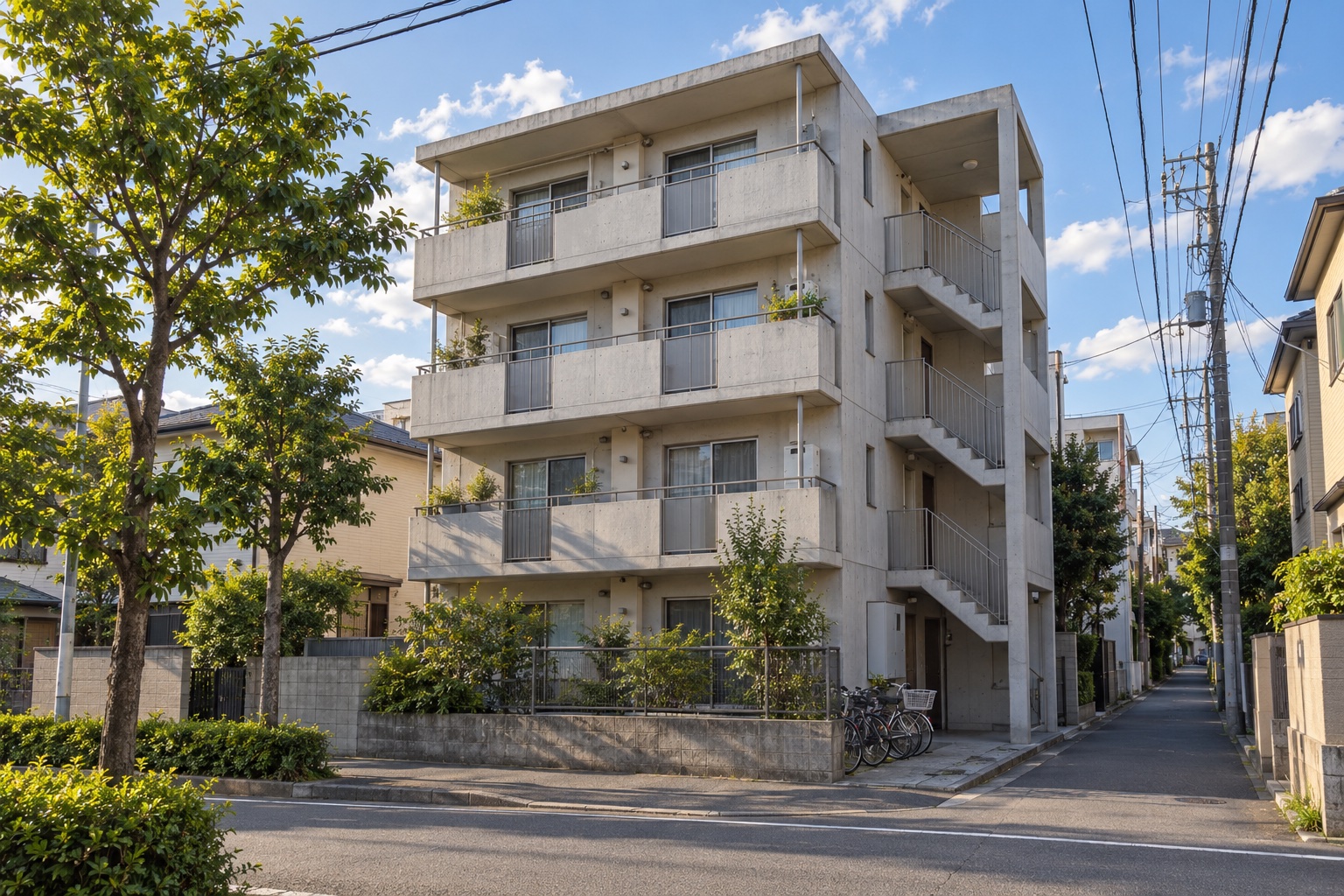
An Osaka apartment building for sale is a different purchase from a single flat: with the building may come land rights, tenants, leases, a management contract and decades of repairs, or the lack of them. As of September 1, 2026, this guide sets out what to inspect before you treat one as an Osaka property investment: the building's condition, its approval and inspection papers, its repair history, the tenancy documents, the management, and the disaster maps for the address. Do these checks before you weigh the price or the yield on the listing; an architect can judge the building, and your agent and a lawyer can tell you what the contracts mean. Tax, financing and visas are outside this guide.
What changes when you buy the whole building
With a single flat, other owners share the building with you. If you buy a whole apartment building outright, nobody does: the roof, the outside walls, the pipes, the stairs, any lift, and the plan for paying for their upkeep are yours to arrange, although a management contract may hand parts of the work to a company.[1]
Two things to establish early. First, whether the land is sold with the building or is leased (借地権, shakuchiken). Second, which tenants, leases, records and management or sublease contracts come with the sale. What passes to you, and on what terms, is a legal question; put it to your agent and a lawyer before you sign.[1]
Read the yield on an Osaka apartment building listing
If a listing shows a yield (利回り, rimawari), read the notes printed next to it before you compare buildings. Ask the agent which rents the figure assumes, whether those rents are being paid now, which costs it leaves out, and whether the price it divides by includes the costs of buying. Treat the yield as a figure to question, not as a forecast of income.
The building's condition
In Osaka Prefecture, 886,200 occupied homes, or 21.1% of the total, were built in 1980 or earlier, according to the 2023 Housing and Land Survey.[2] To judge a particular building, look beyond the year it was built:
- Ask when the building's construction was approved, which earthquake-resistance standard it was designed to, and whether it has had a seismic evaluation or retrofit.
- Commission a building survey. Japan has architects trained as building condition inspectors (既存住宅状況調査技術者). They survey existing homes under a national method, and you can find them through the search pages of the training bodies listed by the Ministry of Land, Infrastructure, Transport and Tourism (MLIT). The method covers apartment buildings and includes a building-level survey, not only a survey of one flat.[3] Ask the inspector what the survey looks at and what it does not; a seismic evaluation or a check of the equipment may need to be ordered separately.
- Ask the city about help with seismic work. Osaka City names an Uemachi fault earthquake and a Nankai Trough earthquake as concrete risks, and lists a subsidy programme for seismic evaluation and retrofit of privately owned apartment buildings. Ask the city whether a particular building can use it.[4]
Approval and inspection papers
Ask the seller for the building's confirmation certificate (確認済証, kakunin-zumi-shō), its certificate of inspection after completion (検査済証, kensa-zumi-shō) and the drawings. With older buildings, the second one may not be available. By MLIT's figures, the certificates of inspection issued in fiscal 1998 equalled about 38% of the building confirmations that year, and in fiscal 2016 about 90%.[5] In 2014 MLIT published guidance on surveying buildings that have no certificate of inspection, in which it noted that in 1999 and earlier, buildings that had not received one made up more than half. In April 2025 that guidance was folded into a broader guideline on surveying existing buildings.[6]
If the certificate is missing, do not guess what that means for this building. Ask your agent and an architect what a survey would show, and what a missing certificate could mean for repairs, changes of use or a later sale.
Repair history and the plan ahead
MLIT's guidebook for private rental housing asks owners to plan maintenance over the long term and to keep records of each repair, including drawings and site photos. A 2019 MLIT report on rental housing lists the original design documents and the repair history among the papers to gather before drawing up a long-term repair plan.[7]
Ask for:
- the repair history: what was done, when, by whom and at what cost
- any long-term repair plan, and what it expects to need next (roof, walls, waterproofing, water and drain pipes, lifts)
- any inspection reports for the fire equipment and the lifts
- a list of known defects, leaks and complaints
Missing records do not by themselves tell you the building's condition. Ask an architect what a survey can and cannot show.
Tenancy documents
These papers show the income you would be buying, so compare them with the money actually received.
- The rent roll (レントロール). For each unit: occupied or empty, rent, deposit and other sums held, start of the lease, and any arrears.
- The lease contracts themselves, not only the summary, including any special terms.
- Vacancy and turnover over the past few years, and how long empty units took to let.
- Deposits and arrears. Ask a lawyer who will owe the tenants their deposits after the sale, what happens to rent that is unpaid at the sale, and whether and how either is settled between seller and buyer at completion.
Then look at the wider market. The 2023 Housing and Land Survey put Osaka Prefecture's vacancy rate at 14.2%, above the national 13.8%. Of 701,900 empty homes in the prefecture, 436,100 (62.1%) were homes for rent. In Osaka City the rate was 16.1%, and 204,000 of its 294,600 empty homes were for rent.[8] These figures cover all housing, not only buildings like the one you are viewing.
Population figures come from a different survey and a later date. In the prefecture's own preliminary count for the 2025 census, taken on October 1, 2025, Osaka Prefecture had 0.83% fewer people than in 2020, while Osaka City grew by 56,212 (2.04%) to 2,808,624, the largest increase in number of any municipality in the prefecture. The city's households rose by 7.91%, and the average household had 1.77 people. The prefecture notes that its count may differ from the national results.[9] For the units in one building, ask your agent how quickly comparable units nearby have let, and at what rents.
Who manages the building
From abroad, the management company is your eyes on the building. Ask who it is, what the contract covers (rent collection, finding tenants, repairs, cleaning, emergencies), how it reports to the owner, and whether the contract continues after the sale. Rental housing management companies registered under the law that came fully into force in June 2021 can be looked up in MLIT's company search system; at the end of fiscal 2025, 10,197 were registered.[10]
Some buildings are let as a whole to a company that sublets the units, an arrangement known in Japan as sublease (サブリース). In 2018 MLIT and the Consumer Affairs Agency, later joined by the Financial Services Agency, warned people considering sublease contracts for apartment buildings that disputes had arisen, especially over rent reductions, and urged them to understand the contract and its risks before signing.[11] If the building comes with such a contract, have a lawyer read it (see the questions below).
Earthquakes, floods and fire
- Nankai Trough. Japan's Earthquake Research Committee gives the probability of a magnitude 8 to 9 earthquake in the Nankai Trough within 30 years as "60% to about 90% or more" under one model and 20% to 50% under another, as of January 1, 2026. Neither model is ranked above the other, but the government's earthquake research headquarters asks people to act with the higher figure in mind.[12]
- The Uemachi fault zone. The main section of this fault zone lies beneath the centre of the Osaka metropolitan area. In its re-evaluation of August 28, 2026, the committee says that if its two sections moved together, an earthquake of about magnitude 7.7 could occur (it gives no probability for this); that a somewhat smaller earthquake outside the scope of the evaluation could do great damage if it struck under the city centre; and that an active fault's presence is itself a sign that a large earthquake can occur there. In the same evaluation, it moved the main section into its lowest probability rank, at almost 0% to 0.003% within 30 years (as of January 1, 2026), because the fault's most recent activity now appears to be later than previously thought. It also notes that this rests on surveys at only a few sites, with some pointing out that there is not enough evidence that the whole section moved in that event, and that no probability could be calculated for the coastal section.[13] The rank describes probability, not the damage an earthquake would do. Ask your architect how the evaluation bears on the building's seismic checks.
- Shaking and liquefaction. Osaka Prefecture revised its maps of expected shaking and liquefaction for a Nankai Trough earthquake and for earthquakes on inland faults, including the Uemachi fault zone, on March 31, 2026. The estimates use a 250 m grid and may not match a particular plot. They ignore ground improvement, and a low liquefaction rating is not a guarantee.[14]
- Floods, storm surges and tsunamis. Osaka City's ward maps show expected flooding from rivers, from rainwater that drains cannot carry away, from storm surges and from tsunamis. Areas outside the mapped zones can still flood, and actual depths can differ.[15] The national hazard map portal lets you type in an address and overlay the risks it covers on one map.[16]
- Fire in dense wooden districts. Osaka City's dense residential districts lie mainly around the outer side of the JR Osaka Loop Line, in areas that escaped wartime fires. The city's programme for them treats about 1,300 ha as priority areas. It warns that if, in a large earthquake, many fires started at once and firefighting could not cope, they could spread into a large urban fire, and collapsed old buildings could block the roads needed for escape and rescue.[17] Ask whether the building stands in one of the city's priority areas, and what is around it.
These are maps and estimates for areas, not forecasts for one building. Use them to decide what to ask the architect and the insurer.
What to ask before you make an offer
- Is the land owned with the building, or leased? Ask your agent.
- Which contracts, rights and obligations pass to the buyer, including the obligation to return tenants' deposits, and how are the deposits and other sums held handed over or settled? Ask your agent and a lawyer.
- Under the sublease contract and the law that applies to it, if there is such a contract, can the rent paid to the owner change, and which side can end it, on what conditions? Ask a lawyer.
- Do the rent roll, the lease contracts and the rent actually received match? Ask your agent for bank records or the management company's statements.
- When was construction approved, is there a certificate of inspection, and does the building match its approved drawings today? Ask your agent and an architect.
- Which surveys should you commission, does the equipment need a separate check, and which repairs should come first on what they find? Ask an architect.
- Who is likely to buy a building like this from you later, and how long have similar buildings taken to sell? Ask your agent.
- Which taxes and costs apply when you buy, while you own and when you sell? Ask a tax accountant.
- Can you borrow, and on what terms? Ask lenders.
- Is the address in a flood, tsunami or liquefaction area, or one of the city's priority areas for dense districts? Check the maps yourself and ask your agent.
- Is the brokerage handling the sale licensed? You can look it up by name in MLIT's company search, which lists firms licensed by the ministry and by each prefecture.[18]
Situations that change the order of checks
- The building is old and wooden, or has no certificate of inspection. Have the architect's survey done first. It can change the plan, not only the price.
- A sublease contract comes with it. Read the contract with a lawyer before you look at any yield.
- Many units are empty or rent is in arrears. Find out why before you assume the empty units will let.
- The address sits in a flood or liquefaction area, or a dense district. Decide whether you accept that risk. If you go ahead, it should shape the survey, the insurance and the repair plan.
- You plan to rebuild or change the use. Ask an architect what the site allows before you make an offer.
- You will borrow. Talk to lenders before you shortlist.
Two more points for owners abroad. Arrange how the manager will reach you, who inspects the building, and who acts in an emergency before you complete. And because the rents come in and the repair bills go out in yen, any change in the exchange rate will make both larger or smaller once converted into the currency you measure your returns in.[19]
Start with the list
Use the six checks above to filter your shortlist. To see what is for sale now, browse homes and buildings for sale across Japan and narrow the search to Osaka, or read our Osaka prefecture guide for the main areas and stations. When a building catches your eye, send the questions meant for the agent with your first enquiry.
Sources
- How a whole-building purchase differs from buying one flat, as SORA's editors explain it; not a legal opinion on rights or on what transfers at a sale.
- 2023 Housing and Land Survey: summary for Osaka Prefecture, Osaka Prefecture (February 28, 2025)
- Training system for building condition inspectors, Ministry of Land, Infrastructure, Transport and Tourism (archived August 30, 2026); Commentary on the survey method for existing homes, MLIT (October 25, 2024)
- Promoting seismic upgrades of private buildings, Osaka City (March 18, 2026)
- Overview of the building confirmation and inspection system, MLIT (March 14, 2019); White Paper on Land, Infrastructure, Transport and Tourism, fiscal 2005 edition, MLIT
- Guideline for surveying buildings without a certificate of inspection, MLIT (July 2014) and its announcement, with a note on the merger into the guideline on surveying existing buildings from April 1, 2025 (July 2, 2014); Promoting the use of existing buildings, MLIT
- Planned repair guidebook for private rental housing, MLIT; Promoting planned maintenance and upgrading of rental housing, MLIT (March 2019)
- 2023 Housing and Land Survey: summary for Osaka Prefecture, Osaka Prefecture (February 28, 2025); 2023 Housing and Land Survey, basic results on housing and households, Statistics Bureau of Japan (September 25, 2024)
- Population and households in the 2025 Census (preliminary), Osaka Prefecture (May 22, 2026) and its attached results
- Results of nationwide inspections of rental housing management companies, fiscal 2025, MLIT (June 5, 2026); Rental housing management company information, MLIT (archived March 13, 2026)
- Caution for those considering sublease contracts for apartment buildings, Financial Services Agency, Consumer Affairs Agency and MLIT (March 27, 2018, updated October 26, 2018); MLIT announcement with the Consumer Affairs Agency (March 27, 2018); MLIT announcement with the Financial Services Agency and the Consumer Affairs Agency (October 26, 2018)
- Updated long-term earthquake probabilities (as of January 1, 2026), Earthquake Research Committee (January 14, 2026); Guide to the long-term evaluation of seismic activity in the Nankai Trough (second edition, partial revision), Headquarters for Earthquake Research Promotion (page updated August 28, 2026)
- Long-term evaluation of the Uemachi fault zone (partial revision), Earthquake Research Committee (August 28, 2026)
- Seismic intensity distribution and liquefaction potential (published March 31, 2026), Osaka Prefecture (March 31, 2026)
- Flood hazard maps, Osaka City Crisis Management Office (March 23, 2026)
- Hazard Map Portal Site, MLIT and Geospatial Information Authority of Japan; Hazard Map Portal Site renewal, Geospatial Information Authority of Japan (May 30, 2023)
- Osaka City programme for dense residential districts (March 2021, mid-term review March 2026), Osaka City (archived March 31, 2026)
- Search system for construction and real estate businesses, MLIT
- SORA editors' advice for owners who live abroad; not tax, legal or currency advice.
Related articles
 Topics
SORA Forms a Business Alliance with Baashir Advisory Group in Hong Kong
SORA Co., Ltd., the operator of realestatejapan.jp, has entered into a business alliance with Baashir…
October 6, 2026
 Guide
GuideBefore You Buy a ¥100 Million Condo in Japan: Documents to Request
Before you make an offer on a resale condominium in Japan, ask your agent for four documents: the management…
October 6, 2026
 Guide
GuideBuying Property in Japan: 7 Things to Check Before You Make an Offer
Before you make an offer on a home in Japan, 7 things deserve a clear answer, and most of them concern how…
September 17, 2026