

Tokyo Houses for Sale: How a Detached House Differs from a Condo
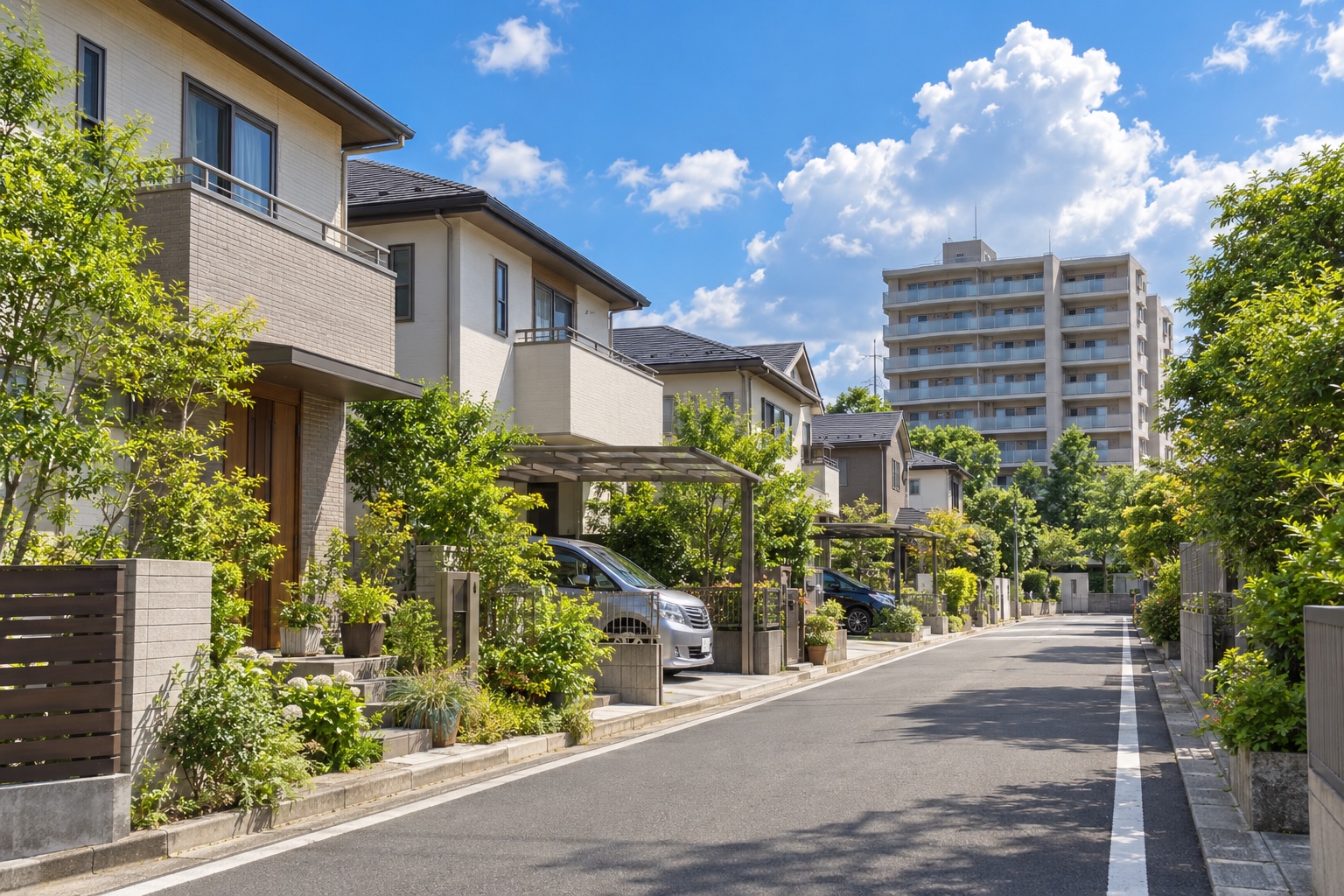
If you are browsing Tokyo houses for sale, you will soon find yourself weighing a detached house against a condo. Neither is better in every case; the real difference lies in what you own and how the property is managed. With a detached house (ikkodate), you usually buy the building together with the land it stands on (some houses stand on leased land), and you arrange repairs yourself; with a condo (called a "mansion", or manshon, in Japan), you buy your own unit plus rights to the common parts and the land that you share with the other owners, and the building is run by an owners' association (kanri kumiai) made up of all the unit owners. If you spend long periods outside Japan and would rather leave repairs to the common parts to the owners' association, a condo is easier to arrange; if you want land of your own and more indoor floor area, a detached house is worth a look, but first check the road the land faces, whether a house can be rebuilt there, and whether the land is leased (information as of August 25, 2026).
| Detached house (ikkodate) | Condo unit (manshon) | |
|---|---|---|
| What you own | The building and the land (some properties stand on leased land, known as shakuchi) | Your own unit, plus rights to the common parts and the land, held together with the other owners |
| Management and repairs | The owner plans and arranges them | The owners' association arranges the common parts; the inside of the unit is the owner's own responsibility |
| Regular costs | Usually no owners' association management fee, but you set aside money for repairs yourself | Usually a monthly management fee plus a repair reserve fund contribution (shūzen tsumitatekin, money saved in advance for future repairs to the common parts), and the amounts can change |
| What to look at closely before buying | The road the land faces, whether a house can be rebuilt, whether the land is leased, when it was built and its condition | How the owners' association is run, the long-term repair plan, how much the repair reserve fund has built up |
Terms first: ikkodate, manshon and floor area
In this article, a manshon means a multi-unit residential building divided into many units that can be bought and sold individually (a bunjō manshon, or condominium sold by the unit), not a rental apartment building; despite the English word, it does not mean a large private house. This article calls a unit in such a building a "condo". An ikkodate is a building containing a single home, so you own the whole building. Most of Tokyo's detached houses are wooden (see the next section), so when you view one, look at its structure and the year it was built as well.
A note for readers from Taiwan. Under the operating manual for Taiwan's actual-price registration system issued by the Ministry of the Interior, a 公寓 is a sectionally owned building without an elevator, a 華廈 is a sectionally owned building with an elevator and 10 floors or fewer, a 住宅大樓 is a sectionally owned residential building with an elevator and 11 floors or more (recorded as 大樓 in sale cases), and a 透天厝 is a whole building with a single house number.[1] By that classification, a Japanese manshon could be a 公寓, a 華廈 or a 住宅大樓, depending on whether it has an elevator and how many floors it has. In this article "condo" covers all of these, not only buildings without an elevator. An ikkodate, like a 透天厝, is a whole building.
Floor area is counted differently too. The exclusive floor area (senyū menseki) of a Japanese condo covers only the unit itself and leaves out corridors, elevator halls and other common parts. Under the Ministry of the Interior's mandatory terms for Taiwan's standard contract for the sale of existing homes, the sale of a registered home is based on the registered area, and what is sold includes a share of the common parts (commonly called 公設).[2][3] So the exclusive floor area on a Japanese condo listing cannot be set directly against the ping figure on a Taiwanese title deed.
How common are detached houses in Tokyo? More than seven in ten homes are in multi-unit buildings
According to the Housing and Land Survey by Japan's Ministry of Internal Affairs and Communications (figures as of October 1, 2023), Tokyo had 1,900,500 occupied detached houses, or 26.3% of all occupied homes, and 5,180,700 homes in multi-unit buildings (kyōdō jūtaku), or 71.6%. No other prefecture in Japan has a higher share of multi-unit housing.[4]
The same survey shows that about 87% of Tokyo's detached houses are wooden. Within the 23 special wards alone, detached houses make up about 21% of homes.[5] Put simply, most of Tokyo's housing is in multi-unit buildings, and most of the city's detached houses are built of wood. These figures describe the existing housing stock (rental housing included), not the share of homes currently for sale.
Ownership: is the land yours?
A condo unit. Under Japan's Act on Building Unit Ownership, the part of the building that belongs to you alone is called the exclusive area (senyū bubun). The common parts, such as corridors and stairs, as a rule belong jointly to all the unit owners, and all the unit owners together form a body that manages the building and its land, generally called the owners' association. The Act also provides that where the right to use the site (shikichi riyō-ken) is held by several owners, an exclusive area and that right cannot, as a rule, be disposed of separately (unless the management rules provide otherwise). This land right is not necessarily a co-ownership share of the land itself; it can also be a leasehold right.[2] The model management rules of the Ministry of Land, Infrastructure, Transport and Tourism (MLIT), a template whose actual versions can differ from building to building, also list the management fee and the repair reserve fund as charges that unit owners pay to the owners' association, and the Tokyo Metropolitan Government puts it plainly: owning a condo means becoming a member of the owners' association.[2]
A detached house. When you buy a detached house, you usually buy the building and the land beneath it. Japan also has properties on leasehold land (shakuchi-ken, the leasehold land right). A leasehold right is a right to use someone else's land in order to own a building on it, in the form of either a superficies (chijō-ken) or a land lease (tochi chinshaku-ken).[6] As MLIT explains, there are several kinds of leasehold, such as ordinary leaseholds and fixed-term leaseholds, and their terms and renewal conditions differ; leasehold rights created before August 1, 1992, when the Act on Land and Building Leases took effect, remain governed in part by the earlier law even after renewal.[6] So two detached houses can be held in quite different ways, and dealt with differently later on, depending on whether the land is owned or leased. Check how the rights are described in the listing, the ground rent and the contract terms with your agent, and consult a professional where needed.
Upkeep: who arranges management and repairs
With a detached house, the owner arranges it. The Japan Housing Finance Agency, an incorporated administrative agency, publishes rough maintenance guides for wooden detached houses. For example, it suggests considering a full repair of ceramic siding walls (yōgyō-kei saidingu) after about 15 to 20 years, full re-roofing of a decorative slate roof (keshō surēto) after about 15 to 30 years, and replacing a water heater after about 10 years. The agency stresses that these are only rough guides and vary with the construction method, specifications and local climate.[7] There is usually no owners' association saving repair money on your behalf, so deciding when to repair and how much to put aside is up to you.
With a condo, the owners' association follows a plan. MLIT's guidelines for long-term repair plans state that the plan should cover a period of 30 years or longer that includes 2 or more large-scale repairs, and assume that the plan is reviewed roughly every 5 years.[8] The repair reserve fund that unit owners pay into each month is money saved in advance for these repairs to the common parts. The advantage is that there is a plan and a body to carry it out; the other side is that repairs to the common parts follow the owners' association's plan, not the wishes of any single owner. The guidelines describe what should be done; whether a given building actually has such a plan and enough money set aside still has to be checked building by building. Repairs inside the unit remain the owner's own responsibility.
A building condition survey when buying a resale home. Japan has a building condition survey (tatemono jōkyō chōsa, often called an "inspection"). It is carried out by an architect (kenchikushi) who has completed a course run by a body registered with the national government, known as an existing-housing condition surveyor, who examines the structurally important parts of the building and the parts that keep rainwater out, using visual checks, measurements and similar methods. MLIT's handbook points out that the results are not a promise that the house has no defects at all, and that parts that cannot be examined may be left out.[9] If you are buying a resale detached house, you can ask your agent whether the house has had such a survey, or whether one can be arranged.
Houses and condos side by side: prices, floor areas and sales numbers
Data for July 2026, published by the East Japan Real Estate Information Network (REINS) on August 10, 2026, show the following closed sales of resale detached houses and resale condos in Tokyo reported to REINS. They are not every transaction in Tokyo; all figures except the number of sales are averages, and the table is compiled from REINS data.[10][11]
| Closed sales, July 2026 | 23 wards: detached houses | 23 wards: condos | Tama area: detached houses | Tama area: condos |
|---|---|---|---|---|
| Number of sales | 274 | 1,509 | 208 | 354 |
| Average sale price | ¥74,940,000 | ¥77,570,000 | ¥43,380,000 | ¥37,950,000 |
| Land area | 82.49 m² | — | 142.79 m² | — |
| Building area / exclusive floor area | 95.55 m² | 56.18 m² | 103.66 m² | 64.93 m² |
| Building age | 25.15 years | 25.76 years | 23.80 years | 28.57 years |
The Tama area covers the cities and towns of western Tokyo outside the 23 wards. In the table, the building area of a detached house is the floor area of the whole house, while the exclusive floor area of a condo covers only the unit, so the two are measured differently. Detached houses and condos also sell in different mixes of locations, so the columns do not compare like-for-like neighborhoods. The detached houses sold in the 23 wards this month had an average land area of 82.49 m²; an average does not show how the plot sizes are spread. These are averages for a single month: only a modest number of detached houses in the wards sell each month, and a few high-priced sales can move the average, so the figures do not tell you the market price of any individual property.
Looking at a full year, 3,999 resale detached houses and 21,912 resale condos in Tokyo's 23 wards were reported to REINS as sold in 2025, so condo sales were about 5.5 times detached-house sales.[12] More sales means more comparable transactions to look at, but it does not mean that every condo is easy to sell. REINS notes that system changes made from January 2025 onward may have affected the number of recorded sales. Because of that, the 2025 counts and the ratio between them should be compared with earlier years with care.[12]
Valuing a detached house: the building and the land
How the building is valued. In guidance issued in 2014, MLIT pointed out that for resale detached houses in Japan, the usual practice at the time was to treat the building's market value as zero after roughly 20 to 25 years, whatever its condition; the guidance set out to improve this way of valuing houses.[13] When you look at the price of a detached house, you can ask your agent to explain how much of it reflects the land and how much the building, and whether the condition of the building is reflected in the price.
The road the land faces. Shinjuku City explains that, as a rule, nothing can be built on a plot that does not adjoin a road as defined by the Building Standards Act, and that when land is bought or sold it is important to check what type of road the plot adjoins.[14] Taking Minato City as an example, you can look up road types on its designated road map (shitei dōro zu), but the city points out that the map cannot be used to confirm the exact width or boundaries of a road, cannot be used to judge whether a plot meets the road-frontage conditions, and cannot be used as material for real estate transactions.[14] To learn which situation applies to the land you are considering, and whether a house could be rebuilt on it in future, ask your agent to look into it with the responsible government office and to give you the results in writing.
Disaster risk: the building and the neighborhood
When it was built. The earthquake-resistance standards of Japan's Building Standards Act were reviewed on June 1, 1981; the standards used before then are known as the old earthquake-resistance standards (kyū-taishin kijun).[15] For wooden houses built with the conventional Japanese post-and-beam method (zairai jikugumi kōhō), the specifications for joints and the way walls are laid out were clarified in 2000. MLIT also explains that in the 2016 Kumamoto earthquakes, some houses of this type that were built to the newer standards but before 2000 also collapsed or suffered other damage.[15] Since most of Tokyo's detached houses are wooden, when you look at a resale detached house, ask for the documents and date of its building confirmation (kenchiku kakunin, the official review of building plans), when it was constructed, and whether it has had a seismic assessment or reinforcement work. For a condo built under the old standards, you can also ask whether it has had a seismic assessment. Which standard a building falls under, and how earthquake-resistant it is today, are each questions to have an architect or other specialist confirm.
How risky the area is. Tokyo's Survey of Regional Risk Related to Earthquakes (the 9th edition, published in September 2022) covers 5,192 town blocks (chōme, the neighborhood units used in Japanese addresses) that include urbanization promotion areas, and rates each one for building collapse risk, fire risk and overall risk on 5 relative levels. After analyzing the higher-risk areas, the report considers a high density of buildings and a high share of wooden buildings built in 1980 or earlier to be likely factors behind higher building collapse risk, and that fire spreads easily where wooden buildings are packed closely together.[16] Tokyo has also identified about 7,100 hectares as "areas crowded with wooden houses" (identified in 2025).[17] When house hunting, you can check what level the property's town block has in the regional risk survey, and whether it lies in one of these areas.
Flooding and soil liquefaction. The Hazard Map Portal Site run by Japan's MLIT lets you look up risks such as flooding, landslides, storm surges and tsunami by address.[18] Tokyo also publishes the Tokyo Liquefaction Prediction Map (the Reiwa 7 revision, released on March 29, 2026), which shows the relative likelihood of liquefaction on a grid of 250 m by 250 m squares. It is not a prediction for any specific earthquake, and it cannot be used on its own to judge an individual plot. The map also notes that if a land or building transaction requires a liquefaction assessment, a separate detailed survey should be carried out.[18]
Earthquakes in southern Kanto. In the long-term evaluation by Japan's Headquarters for Earthquake Research Promotion, the probability of an earthquake of around M7 associated with plate subduction along the Sagami Trough (in the southern Kanto region) occurring within 30 years is put at around 70%, calculated with January 1, 2026 as the reference date. That figure is for an earthquake anywhere within the whole area assessed; it is not a probability for the particular plot you are considering.[19] Whichever you choose, a house or a condo, checking the building's earthquake resistance and preparing your household for disasters remain necessary.
House or condo: matching the choice to your situation
- You live mainly outside Japan and are away for long stretches: a condo already has a shared mechanism, the owners' association, for looking after the common parts, which makes management easier to hand over. You will still need someone to deal with the equipment and any leaks inside the unit, the payment of the management fee and repair reserve fund, and notices of the owners' association's general meetings. With a detached house, someone has to keep an eye on the exterior walls, roof, garden and equipment while you are away, so decide in advance who that will be.
- You want land of your own, more indoor space, or to plan the timing of renovations and repairs yourself: a detached house is the better fit. The work itself may still be limited by laws and regulations or by a land-lease contract, so check with an architect or other specialist first; properties meeting the conditions on the road, rebuilding, leased land and year of construction may also be fewer than you expect.
- You care about having comparable sales when you eventually sell: condos have more recorded sales, so you can ask your agent whether there are past sales in the same building or of properties with similar conditions. The land conditions of a detached house (the road, whether a house can be rebuilt, whether the land is leased) differ from one property to the next, so its sales records have to be compared case by case.
- The condo you like has management problems: for example, if the long-term repair plan has not been revised for years or the repair reserve fund is clearly below what it should be, that can also be a reason to think again.
Questions for your agent, the local government or a specialist
Detached house
- Land rights: freehold or leasehold; for a leasehold, its type, term, ground rent and renewal conditions
- The road: which type of road under the Building Standards Act the land adjoins, and whether a house can be rebuilt in future (ask your agent to check with the responsible government office and explain the result in writing)
- Whether the land's boundaries have been settled, and whether anything crosses the boundary with neighboring land
- The building-confirmation documents and date, whether the building passed its completion inspection and the related certificates, and any record of seismic assessment or reinforcement
- The results of any building condition survey (inspection), and past repair records (exterior walls, roof, water supply and drainage pipes)
- What the hazard maps, the liquefaction prediction map and the regional risk survey show for the property's location
- Who will check on and maintain the house while you are out of Japan
Condo
- The management rules (kanri kiyaku), the long-term repair plan (and when it was last revised), and the minutes of the owners' association's general meetings for recent years
- How the repair reserve fund is built up, the current balance, planned increases, and whether there are arrears for the unit or for the building as a whole
- The building-confirmation documents and date, any record of seismic assessment or reinforcement, and the record of large-scale repairs
- Whether the land right is ownership or leasehold
This article compares only how detached houses and condos are owned and managed, and does not cover tax, loans or visas; please check those separately with a tax professional, a lender and an appropriate specialist.
Pick the type first, then look at properties
If the differences above have drawn you toward one type, a good next step is to look through the properties currently listed, which also cover areas outside Tokyo. If you have not yet settled on where in Tokyo to search, the Tokyo area guide gives an overview of each ward. And when a particular detached house catches your interest, two questions are worth putting in your very first inquiry: is the land owned or leased, and can a house be rebuilt on the road it faces?
Sources
- 不動產成交案件實際資訊申報登錄及預售屋銷售資訊備查作業手冊 (Operating manual for registering actual real estate transaction prices and pre-sale housing information) (Ministry of the Interior, Taiwan, August 2023; posted by the Land Administration Bureau, Taichung City Government)
- 建物の区分所有等に関する法律 (Act on Building Unit Ownership, etc.) (e-Gov Law Search, version in force from April 1, 2026, Articles 2, 3, 11 and 22); マンション標準管理規約(単棟型) (Model management rules for condominiums, single-building type), Article 25 (MLIT, version amended in August 2017; Article 25 reads the same in the version amended in June 2024); マンションの管理のポイント (Key points of condominium management) (Tokyo Metropolitan Government, February 2020)
- 成屋買賣定型化契約應記載及不得記載事項 (Mandatory and prohibited terms of the standard contract for the sale of existing homes) (Ministry of the Interior, Taiwan, announced December 19, 2025)
- 令和5年住宅・土地統計調査 住宅及び世帯に関する基本集計 結果の概要 (2023 Housing and Land Survey: summary of basic tabulations on dwellings and households) (Statistics Bureau, Ministry of Internal Affairs and Communications, September 25, 2024); 令和5年住宅・土地統計調査 東京都の概要(住宅の建て方) (2023 Housing and Land Survey: overview for Tokyo, by type of building) (Statistics Division, Bureau of General Affairs, Tokyo Metropolitan Government, May 15, 2025)
- 令和5年住宅・土地統計調査 第7-1表 (2023 Housing and Land Survey, Table 7-1) (Statistics Bureau, Ministry of Internal Affairs and Communications, e-Stat, September 25, 2024)
- 借地借家法 (Act on Land and Building Leases) (e-Gov Law Search, Article 2 and supplementary provisions); 定期借地権の解説 (Explanation of fixed-term leaseholds) (MLIT)
- マイホーム維持管理の目安【一戸建て(木造住宅)】 (Home maintenance guide: detached wooden houses) (Japan Housing Finance Agency, April 2022); 入居後の住まいの保守管理 (Looking after your home after moving in) (same)
- 長期修繕計画作成ガイドライン (Guidelines for preparing long-term repair plans) (MLIT, revised June 2024)
- 建物状況調査(インスペクション)活用の手引き (Guide to using building condition surveys) (MLIT, April 2024)
- 月例速報 Market Watch サマリーレポート 2026年7月度 (Monthly Flash Report Market Watch summary, July 2026) (REINS (East Japan Real Estate Information Network), August 10, 2026)
- 月例速報 Market Watch 2026年7月度 データ (Monthly Flash Report Market Watch data, July 2026) (REINS, August 10, 2026)
- 首都圏不動産流通市場の動向(2025年) (Trends in the Tokyo metropolitan area real estate market, 2025) (REINS, January 20, 2026)
- 中古戸建て住宅に係る建物評価の改善に向けた指針 (Guidelines for improving how buildings are valued in resale detached houses) (MLIT, March 2014)
- 建築基準法の道路種別の確認 (Checking road types under the Building Standards Act) (Shinjuku City); 建築基準法の道路種別 (Road types under the Building Standards Act) (Minato City)
- 耐震化の流れ (The process of making buildings earthquake-resistant) (Tokyo Metropolitan Government); 新耐震基準の木造住宅の耐震性能検証法の公表について (Publication of a method for verifying the seismic performance of wooden houses built to the new standards) (MLIT, May 16, 2017); 熊本地震における建築物被害の原因分析を踏まえた主な取組方針(参考資料) (Main policy measures based on the analysis of building damage in the Kumamoto earthquakes, reference materials) (MLIT)
- 地震に関する地域危険度測定調査報告書(第9回) (Report on the survey of regional risk related to earthquakes, 9th edition) (Bureau of Urban Development, Tokyo Metropolitan Government, September 2022); 同 第2章 (same, Chapter 2), 同 第3章 (same, Chapter 3)
- 防災都市づくり推進計画 基本方針 (Basic policy of the plan for promoting disaster-resilient urban development) (Tokyo Metropolitan Government, March 2025, partly revised March 2026)
- ハザードマップポータルサイト (Hazard Map Portal Site) (MLIT and Geospatial Information Authority of Japan); 東京の液状化予測図 令和7年度改訂版 (Tokyo Liquefaction Prediction Map, Reiwa 7 revision) (Tokyo Metropolitan Government, March 29, 2026)
- 長期評価結果一覧 (List of long-term evaluation results) (Headquarters for Earthquake Research Promotion, January 14, 2026); 相模トラフ沿いの地震活動の長期評価(第二版) (Long-term evaluation of seismic activity along the Sagami Trough, 2nd edition) (same, April 2014)
Related articles
 Topics
SORA Forms a Business Alliance with Baashir Advisory Group in Hong Kong
SORA Co., Ltd., the operator of realestatejapan.jp, has entered into a business alliance with Baashir…
October 6, 2026
 Guide
GuideBefore You Buy a ¥100 Million Condo in Japan: Documents to Request
Before you make an offer on a resale condominium in Japan, ask your agent for four documents: the management…
October 6, 2026
 Guide
GuideBuying Property in Japan: 7 Things to Check Before You Make an Offer
Before you make an offer on a home in Japan, 7 things deserve a clear answer, and most of them concern how…
September 17, 2026