

Hotel for Sale in Japan: What to Check Before Buying a Hotel or Ryokan
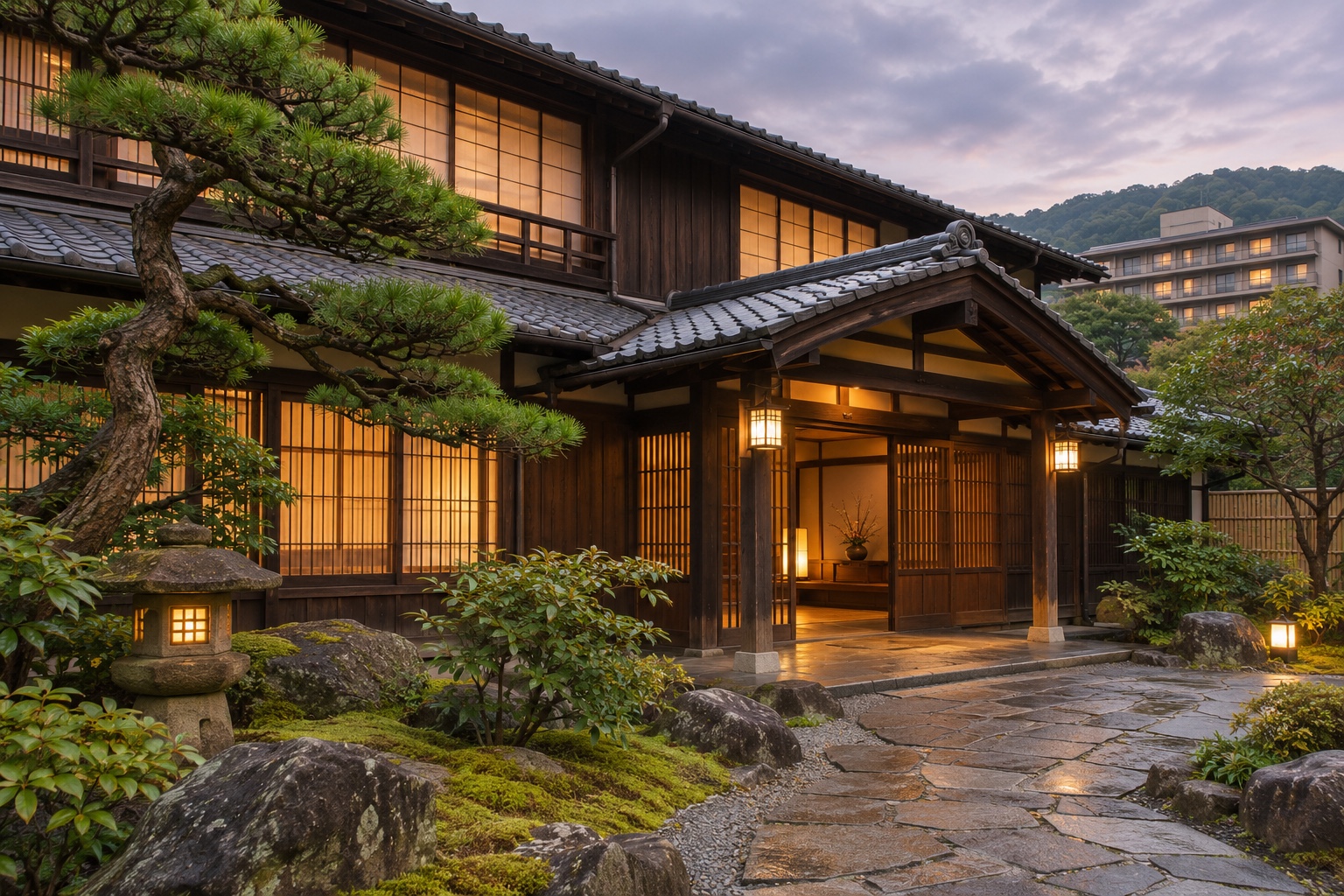
A hotel or ryokan for sale in Japan is usually offered in one of three ways: you buy the building only, the seller conveys the business to you, or you buy the firm that runs it. The questions about the lodging permit differ for each, so ask which one it is first. Then, before you sign, collect four sets of paperwork (the lodging permit, the fire-safety records, the structure's periodic inspection reports and its seismic status) and take the unresolved questions to the permitting authority, the fire service, the building authority and your own lawyer. Content in this guide is as of November 13, 2026.
This guide is for overseas buyers and companies looking at a whole hotel or ryokan, not a single hotel-condo unit. It does not explain the legislation or cover taxation, financing, yields or overall costs; it sets out which documents to ask for, what to watch for on each, and whom to ask. These checks are one component of the investigation before you buy, not all of it; the principal other parts are outlined near the end. To view what is on the market now, begin from our property search.
Hotel or ryokan for sale: first ask which of three deals it is
Start with the vendor's copy of the lodging permit and look at who granted it: the prefectural governor, or the mayor or ward head in a city with a public health centre or in Tokyo's special wards.[1] This office is "the permitting authority" in this guide, and it is where the permit queries below go.
| Building only | Transfer of the business | Purchase of the operating company | |
|---|---|---|---|
| What you receive | Real estate, no running business | The business as defined in the transfer agreement. Whether it includes ownership of the land and building is a point to confirm in the contract | Shares in the company that runs the hotel (it may or may not own the building) |
| Documents to ask the seller for | Building permits, inspection certificates and periodic reports | The draft transfer agreement with its list of assets (land, building, equipment, contracts), the current lodging permit, and a record of any consultation with the permitting authority | The company's registry extract, the land and building registry extracts, the lodging permit, and any plan for a merger or split |
| Question for the permitting authority | Can a new permit be granted for this building on this site?[2] | What approval do the seller and buyer need for the transfer?[3] | Does the planned merger or split need your approval?[4] |
| Question for your lawyer | How will bookings, contracts and staff be handled when the old business closes? | Which assets and contracts are in the agreement, and how will each employee move to the buyer?[5] | Which liabilities stay inside the company? |
The lodging permit: what to ask for and whom to ask
Ask the vendor for:
- a copy of the current lodging permit, and check that the holder's name matches the seller or the firm you are negotiating with
- the deal structure in writing (building alone, business transfer or corporate deal)
- whether and when they consulted the permitting authority, with any documentation of it. The Ministry of Health, Labour and Welfare's page on business transfers asks sellers to consult in advance.[6]
Next put the question for your deal type to the permitting authority:
- Business transfer. Inquire what approval the vendor and the buyer each need to obtain,[3] what documents it takes and how long it typically takes. Ask the vendor to confirm in writing that they will assist with the approval.
- Company deal. Ask the seller for any plan to merge or divide the company before or after completion, and ask the permitting agency whether that plan requires its approval.[4] Ask your lawyer whether the proposal meets the conditions the agency mentions.
- Building only. Have your operator ask, before you make an offer, whether a fresh permit is likely. Ask specifically whether the premises meet the requirements and whether the location raises public-health issues,[2] and whether any school or similar facility lies within roughly 100 metres.[7]
Ask your lawyer how to make the authorization, or the new licence, a condition of the schedule, so that completion and the hand-over of operations do not get ahead of it.
Restaurant, onsen and staff
Ask the seller which additional permits the business uses besides the lodging licence. For each one, ask for the document and ask the issuing body how it is treated after the sale.
- Restaurant licence. Ask the office that granted the licence whether the restaurant licence can be taken over by notification in your deal, and which of the property's other licences need a fresh application. The ministry's business-transfer page says restaurant licences can now transfer by notification and that handling differs by business type.[8]
- Hot-spring (onsen) permit. Ask the vendor for the permit to supply hot-spring water for public bathing,[9] check whose name is on it, and ask the authority that issued it what happens to it in your deal type.
- Staff. Ask the seller for a personnel list showing who intends to stay. Ask your lawyer how every employee will move to you and whose consent that needs.[5]
Fire-safety records
Ask the vendor for three documents and check each as follows.
- The fire prevention manager's appointment. Check the name and the date of designation. Ask the fire department whether this structure is one where the individual with management authority must appoint a fire prevention manager, and whether the designation on record is current.[10]
- The latest fire-prevention inspection report. Check the date and the results in the report. Ask the fire department whether the building is one that must have the periodic inspection.[11]
- The "Teki" mark. Ask whether the property holds a silver mark or a gold mark; the gold mark is for satisfying the standard 3 years in a row.[12] Ask the fire department whether the property is in the program's scope here. The Fire and Disaster Management Agency's page defines the scope as accommodation with a capacity of 30 or more persons and 3 or more floors above ground, and mentions that local fire departments may set this differently.[13] The mark gets issued only on the establishment's own application, after the fire department assesses the building against fire laws and key structural standards,[14] so if there is none, ask the vendor why.
Questions for the local fire authority: Is this building within the Teki mark coverage here? Has the agency issued any notices on it that are still open?
The building's periodic inspection report
Ask the vendor for the last several periodic survey reports lodged with the local building authority,[15] and read three things on each:
- Who reported. The name should be the proprietor, or the manager where the owner and the manager are distinct.[15] Check that it matches the seller or its manager.
- Who surveyed. The surveyor should be a first-class or second-class architect, or a person holding a Building Survey Inspector Qualification Certificate (kenchikubutsu chōsain shikakushashō).[15]
- What was flagged. Itemize the open items. Outstanding items are not a reason to walk away by themselves, but they show which repairs the vendor has or has not done.
Question for the building authority: Is this building one which must report, either by cabinet order or by your designation, and have the recent reports been filed?[15]
Seismic status: is a diagnosis published?
Ask the building authority first: Is this building a "large building requiring urgent safety confirmation", or another building subject to compulsory seismic diagnosis? The findings of these mandatory assessments are published on the competent authority's website.[16] A structure outside that obligation may have no posted result, so absence from the listing does not mean the building has been checked.
Then consult the authority's own webpage for its scope:
- Hokkaido's page defines the category as structures of a certain scale or larger built to the former seismic code on or before May 31, 1981, such as hospitals, hotels, ryokan and stores used by numerous people.[17] It also indicates that the prefecture releases results for the area it is responsible for, and that cities that are responsible authorities release their own,[17] so consult the city's website as well as the prefecture's.
- Hiroshima City's page uses, in principle, construction started on or before May 31, 1981, and for hospitals, shops, ryokan and similar uses, 3 or more floors and 5,000 square metres or above. It excludes structures that had extension or comparable work on or after June 1, 1981 and received an inspection certificate under the Building Standards Act.[18]
Ask the vendor for the dates on the building's initial building confirmation and inspection certificate, and the documentation of any later addition or alteration, and have your surveyor compare them with the cut-off on the authority's page. Where the threshold is the commencement of construction, as in Hiroshima City, a structure finished after mid-1981 may still fall before it. If the structure is too small for the register, ask the vendor whether a diagnosis was ever done, and for the write-up.
What the 2025 visitor numbers show, and what they don't
Japan received 42,683,600 overseas arrivals in 2025 (estimate), 15.8% more than the year before.[19] National totals do not show demand at one address. A hotel's income depends on its own location, season and personnel, and a firm that relies on foreign guests is exposed if tourism falls, as it can after a pandemic, a disaster or a sudden currency move.
Checklist before you make an offer
| Document or question | Get it from / ask | What it tells you | Warning sign |
|---|---|---|---|
| Lodging business permit | Seller | Permit type, holder and issuing office | The holder is not the seller or company you are dealing with |
| Plan for passing the permit | Seller, then the permitting authority | Transfer approval, company deal, or new permit | No advance consultation yet, and a closing date fixed anyway |
| Restaurant and onsen permits | Seller, then the office that issued each permit | Which other permits the business runs on | No one can say how they will be handled |
| Staff plan | Seller and your lawyer | Who stays after the hand-over | Key staff, such as the cook or fire prevention manager, are leaving |
| Fire prevention manager appointment | Seller | Who is responsible for fire safety now | No one appointed |
| Fire-prevention inspection report | Seller, then the fire department | Open fire-safety items | Open items with no repair plan |
| Teki mark status | Seller / fire department | Whether the building passed the fire-department review | In scope, no mark, and no explanation |
| Building periodic report | Seller, then the building authority | Who reported, who surveyed, open items | Reports missing for recent periods |
| Seismic diagnosis (older large buildings) | Building authority, its published list, then the seller | Seismic result of the building | Construction started before the cut-off, the building is large, and no diagnosis can be shown |
Risks and what would change the decision
- The permit may not pass. If the regulator does not approve the transfer,[3] enquire whether your operator would need a permit of its own.[1]
- A new permit may be refused. For a building-only purchase, facility requirements and location can block a new permit.[2]
- Older buildings. The central government's page recommends considering retrofitting or reconstructing where seismic performance proves insufficient.[16] A published assessment showing low seismic capacity should change your pricing discussion or your choice.
- People leave with the seller. In a family-run inn, the fire prevention manager, the cook and the reservation know-how may all be the seller. If no team stays, you are buying a property that needs a fresh operation.
- Demand moves. Last year's guest growth describes the previous year, not the coming ten.
- The exit. Whoever buys from you later will perform the same checks. Keeping the permit, inspection and earthquake records complete is part of keeping the asset sellable.
What this checklist does not cover
The reviews above tell you whether the licences and the safety records hold up. They do not complete the pre-purchase investigation of a hotel or ryokan. The main areas listed should run in tandem with your own consultants; depending on the asset, there may be others.
| Area still to check | Who usually helps |
|---|---|
| Ownership, registered rights and boundaries of the land and building | A judicial scrivener (shihō shoshi) and a land and house investigator (tochi kaoku chōsashi) |
| Physical condition of the building and equipment (roof, plumbing, boilers, lifts, onsen piping) | An architect or building surveyor |
| Zoning, and what the site may be used for now and after any rebuild | The planning or building department of the local municipality (or the prefecture) |
| Accounts, liabilities and tax position of the business or company | A certified public accountant or a licensed tax accountant (zeirishi) |
| Contracts with booking sites, suppliers, landlords and lenders | Your lawyer |
| Price and the operating plan | Your operator; a licensed real estate appraiser (fudōsan kanteishi) for the property, and an accountant for the value of the business or company |
Even if the licensing authority has confirmed the pathway for the licence, the inspection and fire records have no outstanding items, and the earthquake status is known, the review is not complete until these areas are covered too. If any item in this guide is missing and the vendor will not allow you time to verify, that is a reason not to proceed.
FAQ
Can a foreign buyer own a hotel in Japan? This guide does not address ownership rules or visas. It covers the papers and questions that pertain to the building and the business permit whoever the purchaser is.
Does the hotel's permit come with the building? Do not assume it does. Before you buy, check with the permitting authority what route applies to your deal;[1] for a business transfer, ask what authorization the seller and purchaser need.[3]
Is the Teki mark required? It is granted on the facility's request after a fire-department examination.[14] Treat it as a matter to ask about, not as a substitute for the inspection records.
Where can I find a building's seismic diagnosis? The published results are those of mandatory seismic assessments, for buildings such as large buildings requiring urgent safety confirmation, and they appear on the site of the responsible authority, such as the prefecture or city.[16] A structure outside that duty might have no published finding; ask the seller whether a diagnosis was performed and for the findings.
Next steps
Browse current hotel, ryokan and whole-building listings on our property search, and read the prefecture guides for the region you are considering. When a listing interests you, ask us for the permit, fire-safety and inspection records in the checklist above before you make an offer.
This article constitutes general information, not legal advice. Rules and processes differ by prefecture and municipality; confirm them with the local public health centre, fire department and building authority.
Sources
- Hotel and Inn Business Act, Article 3(1) (e-Gov)
- Hotel and Inn Business Act, Article 3(2) (e-Gov)
- Hotel and Inn Business Act, Article 3-2(1) (e-Gov)
- Hotel and Inn Business Act, Article 3-3(1) (e-Gov)
- Civil Code, Article 625(1) (e-Gov)
- Ministry of Health, Labour and Welfare: Procedures for business transfers
- Hotel and Inn Business Act, Article 3(3) (e-Gov)
- Ministry of Health, Labour and Welfare: Procedures for business transfers
- Hot Springs Act, Article 15(1) (e-Gov)
- Fire Service Act, Article 8(1) (e-Gov)
- Fire Service Act, Article 8-2-2(1) (e-Gov)
- Fire and Disaster Management Agency: Display scheme overview
- Fire and Disaster Management Agency: Display scheme overview
- Fire and Disaster Management Agency: Display scheme overview
- Building Standards Act, Article 12(1) (e-Gov)
- Ministry of Land, Infrastructure, Transport and Tourism: Seismic retrofitting of buildings
- Hokkaido Government: Published seismic diagnosis results (updated August 18, 2026)
- Hiroshima City: Published seismic diagnosis results (updated March 12, 2025)
- JNTO: Visitor arrivals, December 2025 estimate (January 21, 2026)
Related articles
 Topics
SORA partnered with Pressance to welcome visitors at its booth at the Taiwan International Real Estate Expo in Kaohsiung
November 6–8, 2026 — At the Taiwan International Real Estate Expo (TIEE) in Kaohsiung, SORA worked with its…
November 12, 2026
 Topics
SORA Partners with Benham and Reeves, a London Estate Agent
SORA Co., Ltd., the operator of realestatejapan.jp, has entered into a referral partnership with Benham and…
November 12, 2026
 Guide
Buying Property in Japan from Overseas: The Remote Steps
As of 30 October 2026, various formal steps in purchasing property in Japan can be done while you stay…
October 30, 2026