

Buying Property in Kyoto: Machiya or Condo If You Live Overseas
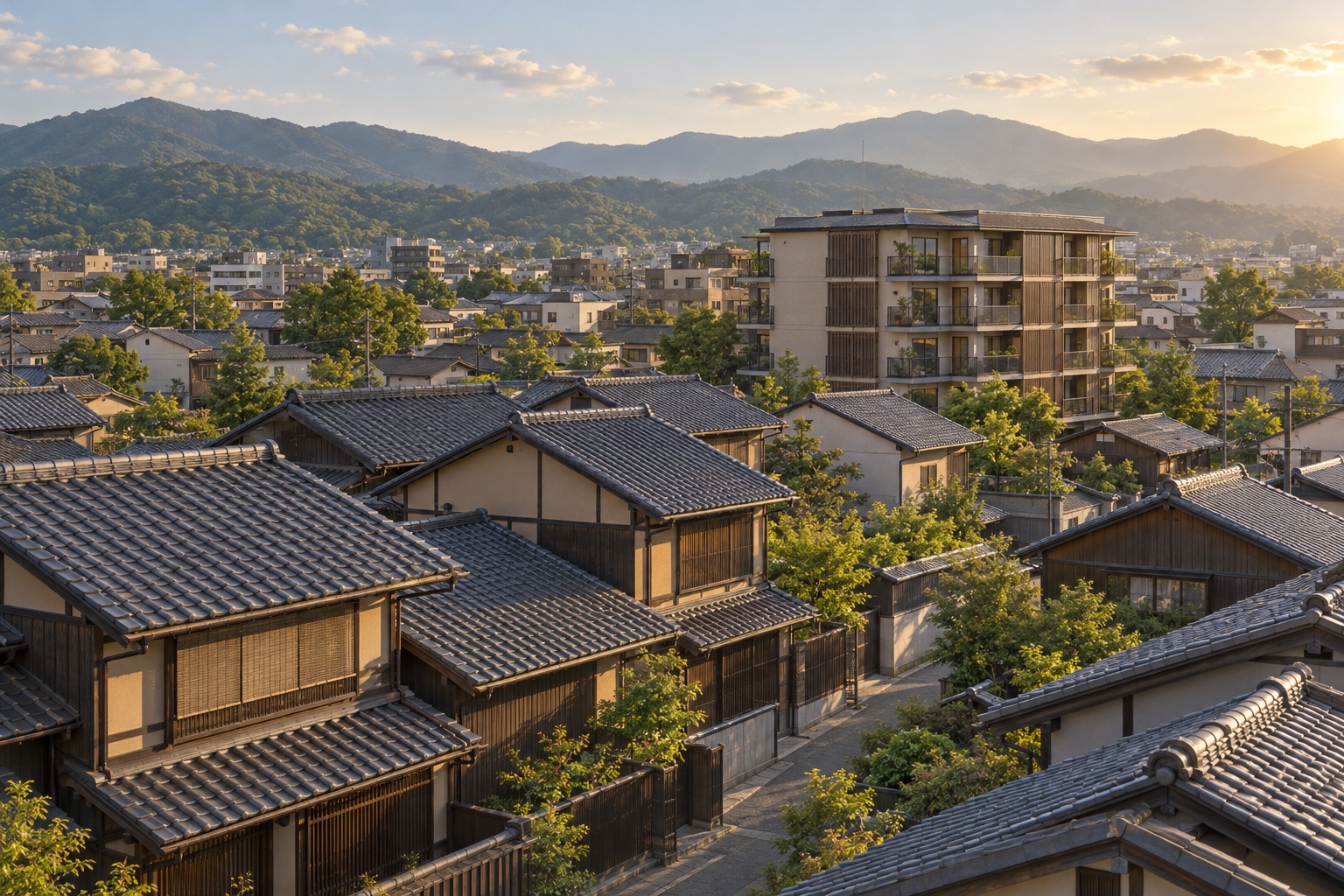
If you are buying in Kyoto but will spend most of your time outside Japan, a condominium is generally easier to arrange: the common areas are managed by the owners' association (kanri kumiai) that all unit owners form together.[1] With a kyomachiya, a wooden townhouse with a traditional structure built in 1950 or earlier, renovation, rebuilding on a narrow alley and care while the house stands empty are mostly for the owner to arrange, so it suits buyers who can return to Kyoto regularly or who have already lined up management and repair help. Whichever you choose, it is best to arrange for someone to visit regularly while the home is empty to check on it, air it out and collect the mail.
This article sets out what to confirm before owning a Kyoto home from abroad, whether you live in Taiwan or elsewhere, as of September 15, 2026. Tax, financing and visas are outside its scope; check those with a specialist.
Kyoto's machiya: where things stand
Kyoto City uses the term kyomachiya for wooden buildings constructed in 1950 or earlier, the year Japan's Building Standards Act took effect, that have a traditional structure and a form or design that grew out of urban life.[2] If you are used to judging old houses at home by structure and rebuild potential, a machiya adds one more question to those two: what happens to a wooden house while nobody lives in it.
Kyoto City's fiscal 2016 machiya survey judged buildings from the outside and covered the districts built up before the war and the old highway routes, not the whole city. Of the 40,146 machiya still standing in that area, it judged 5,834 (14.5%) to be vacant; the previous survey (fiscal 2008–2009) had found 10.5%.[3] The fiscal 2024 survey did not send anyone on site and relied on digital maps and other data instead. Its report did estimate the number of vacant buildings, but considered the estimate's reliability questionable and did not give a vacancy rate that could be compared with the previous one.[3]
The same fiscal 2024 survey found that 27.0% of the machiya judged vacant last time had since been lost (demolished or otherwise), more than 2 times the rate for those judged not vacant (11.5%).[4] This does not mean an empty machiya will inevitably be torn down. What the survey shows is that machiya that were vacant last time were lost at a higher rate.
Kyoto City surveyed owners of individually designated machiya in fiscal 2022 and owners of machiya in designated districts in fiscal 2023. In both surveys, the most common difficulty owners named was "finding the money for renovation and repairs."[5] These answers come from owners of designated machiya and do not represent all machiya, but they show that renovation costs are the difficulty owners raise most often.
Machiya: city schemes for renovation, alleys and subsidies
This section only explains that these schemes exist and what they broadly cover. Whether a particular house qualifies, and what work can be done on it, is something to have your agent and an architect check with Kyoto City.
The historic buildings ordinance. In 2012 Kyoto City brought into force an ordinance on preserving and using traditional wooden buildings; a 2013 amendment gave it its current name, the Kyoto City Ordinance on the Preservation and Utilization of Historic Buildings. Under Article 3, paragraph 1, item 3 of the Building Standards Act, buildings registered and designated under the ordinance are exempted from that Act, and safety is secured instead through fire-prevention and evacuation measures and structural reinforcement.[6] Not every machiya is covered automatically. The owner submits a preservation and utilization plan, the building is registered as a preserved building, and it is then designated with the consent of the Building Review Board. The city's procedure handbook says that going from the registration proposal to designation usually takes 2 to 3 months (not counting time spent on prior consultation), and the Fire Service Act still applies.[6]
Houses on alleys (roji). According to Kyoto City, the city-planning area has about 13,000 narrow streets under 4 meters wide with buildings along them, about 940 km in total length (as of a 2011 survey). Buildings facing a dead-end alley (fukuro-ji) or a lane less than 1.8 meters wide had been difficult to rebuild or to repair on a large scale.[7] Since April 2014 the city has run a scheme that, under certain conditions such as agreement among local residents, designates such lanes as roads under the Building Standards Act so that the buildings on them can be rebuilt.[7] The scheme requires that agreement and other conditions, so it is not something a buyer can decide, and designation brings separate restrictions of its own. If a machiya you are interested in sits on an alley, first ask your agent to find out what kind of road it faces and whether the building can be rebuilt.
Subsidies for renovation and seismic work. Kyoto City's Kyomachiya Renovation Subsidy pays part of the cost of renovation work on a machiya (the subsidy rate and cap were raised for fiscal 2026). Each fiscal year, applications close once the budget runs out, and the construction contract and the start of work must come after the subsidy has been approved.[8] For seismic and fire-safety upgrades there is a separate subsidy called "Machi no Takumi Plus" (まちの匠・ぷらす). Eligible buildings include machiya whose construction began on or before November 22, 1950, with 2 stories or fewer and built with traditional methods, subject to further conditions such as how the building is used. For fiscal 2026 the application period runs from April 13 to December 25 (closing earlier if the budget runs out), and the city says this expanded version of the program runs only through fiscal 2026.[8] Each subsidy has its own eligibility rules and conditions, so whether you could use one has to be checked case by case. There is no need to rush into a purchase to meet a subsidy deadline.
Where to ask about machiya. Advice on renovating, using and inheriting machiya is handled by the Kyoto City Landscape and Community Development Center (京都市景観・まちづくりセンター), a public-interest foundation, mainly for owners and people in a similar position. In 2025 Kyoto City announced that it would merge its consultation and matching schemes and make this center the single contact point.[9] The Kyomachiya Succession Network (京町家等継承ネット), for which the center serves as secretariat, also holds consultation sessions open to people who want to buy or move into a machiya (in 2026, on March 14).[9]
Owning from overseas: who looks after the home while it is empty
Vacant homes in Kyoto. According to the 2023 Housing and Land Survey (a sample-based estimate as of October 1, 2023), Kyoto City had 842,300 dwellings, of which 105,300 were vacant, a vacancy rate of 12.5%. Leaving out homes for rent, homes for sale and second homes such as holiday homes, 44,300 dwellings were vacant.[10] These figures cover all housing, not just machiya. For managing vacant homes, Japan has a national law and Kyoto City has its own ordinance.
The national law and the city ordinance. Japan's Act on Special Measures Concerning the Promotion of Measures for Vacant Houses asks owners of vacant houses to make efforts to manage them properly so that they do not harm the surrounding living environment (Article 5; this is a duty to make efforts, or doryoku gimu). Under amendments that took effect on December 13, 2023, a mayor may first give guidance to the owner of a "poorly managed vacant house" (kanri fuzen akiya) that, if left as it is, could become a "specific vacant house" (tokutei akiya); if there is still no improvement and it is highly likely to become one, the mayor may issue a recommendation (Article 13).[11] Kyoto City's own vacant house ordinance (in force since April 2014) looks at row houses (nagaya) and apartment buildings unit by unit when deciding whether something is a "vacant house," meaning that nobody lives in it or uses it, or a similar state. The ordinance says owners must manage such property properly on their own responsibility so that it does not fall into poor condition (Article 13), and, when they have no prospect of using it, must make efforts to put it to use, for example by renting it out or transferring it (Article 12).[12] Ask Kyoto City in what circumstances your home would come under the ordinance.
What upkeep means in practice. The basic guidelines of Japan's Ministry of Internal Affairs and Communications and Ministry of Land, Infrastructure, Transport and Tourism note that problems in a vacant house are hard to spot and that damage tends to progress faster, so owners need to inspect it regularly and air it out and ventilate it regularly. The guidelines also list keeping water in the drain traps (topping them up) and cleaning them, pruning trees, checking and sorting mail, and closing the main water valve in winter. Where owners live far away and cannot manage the house themselves, they suggest that hiring a management company is an option to consider.[13] In a condo, the owners' association looks after the common areas, but airing out the unit, leaks and mail inside it are, as with a machiya, yours to arrange.
Who you can ask. Kyoto City registers real estate agents as "local vacant house advisers" if they hold the takken-shi qualification (Japan's national qualification for real estate transactions), have at least 5 years of practical experience and have completed city training (about 270 as of April 2026). Advice on vacant houses is free; if you ask them to do specific work such as renting out or selling the property, the usual transaction fees apply.[14] Check in advance whether an owner living outside Japan can use this service and how to contact an adviser.
Two points about property registration. Since April 1, 2024, an application to register someone who lives outside Japan (including a corporation) as owner must give the name, address and other details of a contact person in Japan. The contact can be an individual or a corporation; Japan's Ministry of Justice has in mind real estate businesses, judicial scriveners (shiho shoshi) and the like, and if there is no contact person, the application can state that there is none.[15] This domestic contact is an item recorded in the registry; it is not the same as someone who manages the property for you. Ask a judicial scrivener how the contact details should be registered and whom to name. Separately, from April 1, 2026, property owners must apply to register a change of address or name within 2 years of the change, and failing to do so without good reason may result in a non-criminal administrative fine (karyo) of up to ¥50,000. The system under which the registrar updates the record ex officio cannot be used by people living outside Japan, who must apply for the change themselves (this can be entrusted to a judicial scrivener).[16] Also confirm who will take care of this if you move house in the country where you live.
Housing and tourism in Kyoto: lodging rules under review
Rules on minpaku. Kyoto City figures show that, counted by guest rooms, minpaku make up only about 7% of the city's lodging facilities. In the city's statistics, minpaku means homes registered under the private lodging law plus small lodging businesses (kan'i shukusho) that the city counts as equivalent to minpaku. Yet of the complaints about lodging facilities the city recorded from fiscal 2018 to fiscal 2025, about 74% in total concerned minpaku.[17] Under a city ordinance, a private lodging business (jutaku shukuhaku jigyo) in residential-only zones, the areas set aside mainly for housing, may in principle operate only from noon on January 15 to noon on March 16 each year (there are exceptions). National law already caps operation at 180 days a year.[18] In January 2026 Kyoto City announced tighter minpaku regulation. From February it began dealing more strictly with operators who do not file their periodic reports on time, with measures ranging from publicizing violations and fines to orders to suspend or shut down, and it aims to propose an amendment to its ordinance within fiscal 2026. The draft presented to an expert panel on August 31 includes requiring every small lodging business and registered home to have someone stationed on the premises or in an adjacent building (the city is also considering applying this to existing facilities across the board after a grace period), setting the permitted operating days for newly registered homes (private lodging business) at zero in residential-only and industrial zones (not applying to existing facilities), and considering bringing machiya, in principle, within the scope of the rules as well. These are still draft proposals, not settled rules.[19] If you might want to use the home for lodging in the future, check the latest rules with Kyoto City before you buy; for a condo, the management rules also have to be checked.
Living in a city full of visitors. In Kyoto City's 2025 residents' survey, 79.9% of residents said they were bothered by at least one of crowding on public transport or at tourist sites, traffic congestion and tourists' bad manners (crowding at some tourist sites 70.6%, tourists' bad manners 56.3%). At the same time, 70.1% felt that tourism matters to the city's development. In its Kyoto Tourism and MICE Promotion Plan 2030, adopted in March 2026, the city set 0.0% of residents feeling bothered as a target value to keep working toward, looking ahead to 2030.[20] Living near a well-known sight may affect your daily life, so when viewing a property, walk around the neighborhood once on a weekday and once on a weekend or holiday.
The drawbacks of each
Machiya
- Repair costs and timelines are hard to estimate in advance; subsidies are limited by budgets and deadlines, so you may not be able to use one.
- While the house is empty, damage is hard to spot and tends to progress faster[13]; when you are away from Kyoto, someone has to visit regularly.
- On the other hand, you can plan how the building and land are used yourself (still within the schemes above, and, if the land is leased, within the terms of the land lease), without waiting for a vote by other owners.
Condo
- Management and use must follow the law and the building's own management rules (kiyaku). Under the ministry's Standard Management Rules (a model that each building adapts), the management fee and the repair reserve fund (shuzen tsumitatekin, money set aside for future repairs to the common areas) are set by resolution of the general meeting and may be changed; the rules of the actual building are what count.[1]
- Before renovating, renting out or using the unit for lodging, check the management rules first; there may be restrictions, or you may need to apply for approval.
Situations that change the answer
- You will spend some time in Kyoto every year: you can keep an eye on the house yourself, which makes machiya upkeep easier to arrange.
- The machiya you like is on an alley: designating the road requires conditions such as agreement among local residents, which the buyer cannot decide. Before making an offer, ask your agent to check whether the building can be rebuilt.
- You want to use the home for lodging: Kyoto City is considering stricter rules (the draft also mentions machiya), and these rules could make your plan unworkable.
- The condo you like has a poorly run owners' association: the case for a condo being easier to own from abroad assumes that the association works properly. Look at the long-term repair plan and the state of the repair reserve fund first.
Checklist before owning a Kyoto home from abroad
- Who will visit, air out the home and collect the mail while you are out of Japan, and what that will cost
- Whether Kyoto City's vacant house advisers and similar contact points can be used while you live outside Japan
- How the domestic contact details are registered, and how to state that you have no contact person; who will register a change of address when you move in the country where you live (ask a judicial scrivener)
- Whether the land is owned or leased
- Machiya: whether it is designated (under Kyoto City's machiya ordinance, demolishing a designated machiya in principle requires notifying the city no later than 1 year before work begins, with exceptions; in July 2026 the city published a draft amendment to the ordinance for public comment, including mechanisms to make the demolition notification system more effective)[21]; whether the road it faces allows rebuilding; and which subsidies may apply, when to apply, and the order of signing the construction contract and starting work
- Condo: what the management rules say about renting out, lodging use and renovation, and who will handle the association's notices and payments for you (under an amendment in force since April 1, 2026, a unit owner with no address or residence in Japan may appoint a "domestic manager" (kokunai kanrinin) to receive notices convening general meetings, vote, and pay management fees and other debts owed to the other owners; the law allows this rather than requiring it, but a building's management rules may require one, and the owner has to notify the building's manager after appointing one. This is a separate system from the domestic contact in the property register)[22]
- If you want to use it for lodging: the rules where the property stands and the latest state of Kyoto City's review (check with Kyoto City)
Comparing machiya and condos in Kyoto
Current listings can be narrowed down to Kyoto; take the checklist above with you as you compare them. For an overview of the different parts of the prefecture, see the Kyoto Prefecture area guide.
Sources
- Act on Building Unit Ownership, etc. (建物の区分所有等に関する法律), e-Gov Laws and Regulations (version in force on September 15, 2026; Articles 3 and 30); Standard Management Rules for Condominiums, single-building type (マンション標準管理規約(単棟型)), Ministry of Land, Infrastructure, Transport and Tourism (amended October 17, 2025; Articles 25 and 48)
- What is a kyomachiya? (京町家とは), Kyoto City (archived April 16, 2026); Kyomachiya Renovation Subsidy, fiscal 2026 (京町家改修補助金 令和8年度), Kyoto City (April 2026)
- Results of the fiscal 2016 follow-up kyomachiya survey (平成28年度 京町家まちづくり調査 追跡調査結果), Kyoto City (May 1, 2017); Fiscal 2024 kyomachiya status survey report (令和6年度 京町家状況調査報告書), Kyoto City, Kyoto City Landscape and Community Development Center and Ritsumeikan University (November 2025, p. 45)
- Fiscal 2024 kyomachiya status survey report (令和6年度 京町家状況調査報告書) (November 2025, p. 45)
- Fiscal 2024 kyomachiya status survey report (令和6年度 京町家状況調査報告書) (November 2025, pp. 81–82)
- Kyoto City Gazette: Kyoto City Ordinance on the Preservation and Utilization of Historic Buildings (京都市公報(京都市歴史的建築物の保存及び活用に関する条例)), Kyoto City (November 1, 2013); Exemption from the Building Standards Act, for owners and designers (建築基準法の適用除外とは(所有者・設計者向け)), Kyoto City (updated March 28, 2025); Procedure handbook (手続BOOK), Kyoto City (March 2022)
- Policy on measures for densely built-up areas in the historic city of Kyoto (歴史都市京都における密集市街地対策等の取組方針), Kyoto City (revised March 2021); Road designation scheme for reviving streetscapes with alleys (路地のある町並みを再生するための道路指定制度), Kyoto City (updated April 25, 2022); Press release (広報資料), Kyoto City (March 19, 2014)
- Kyomachiya Renovation Subsidy, fiscal 2026 (京町家改修補助金 令和8年度), Kyoto City (April 2026); Toward preserving and passing on kyomachiya (京町家の保全・継承に向けて), Kyoto City (May 14, 2026); Fiscal 2026 seismic and fire-safety subsidies for homes (令和8年度 すまいの耐震・防火補助制度), Kyoto City (March 13, 2026); Machi no Takumi Plus seismic and fire-safety retrofit support (まちの匠・ぷらす), Kyoto City (July 1, 2026)
- Recruiting new kyomachiya advisers (新たな「京町家相談員」の募集), Kyoto City (May 20, 2025); Kyomachiya Succession Network: 2026 consultation session on kyomachiya and vacant houses (京町家等継承ネット 2026年 京町家・空き家なんでも相談会), Kyoto City (December 15, 2025)
- Summary of the 2023 Housing and Land Survey, Statistical Analysis No. 150 (令和5年 住宅・土地統計調査の概要(統計解析 No.150)), Kyoto City (March 31, 2025)
- Act on Special Measures Concerning the Promotion of Measures for Vacant Houses (空家等対策の推進に関する特別措置法), e-Gov Laws and Regulations (version in force on September 15, 2026; Articles 5 and 13); Cabinet decision on the cabinet order setting the effective date of the amended act (改正法の施行期日を定める政令等を閣議決定), Ministry of Land, Infrastructure, Transport and Tourism (November 17, 2023)
- Kyoto City Ordinance on the Utilization and Proper Management of Vacant Houses (京都市空家等の活用、適正管理等に関する条例), Kyoto City (version as amended December 13, 2023; Articles 2, 12 and 13)
- Basic guidelines for comprehensive and systematic implementation of measures on vacant houses (空家等に関する施策を総合的かつ計画的に実施するための基本的な指針), Ministry of Internal Affairs and Communications and Ministry of Land, Infrastructure, Transport and Tourism (last amended September 3, 2026)
- Talk to a vacant house adviser (空き家相談員に相談しよう), Kyoto City (archived June 7, 2026)
- Applications for ownership registration made on or after April 1, 2024 (令和6年4月1日以降にする所有権に関する登記の申請について), Ministry of Justice (updated December 20, 2024); Real Property Registration Act, Article 73-2 (不動産登記法 第73条の2), e-Gov Laws and Regulations (version in force on September 15, 2026)
- Special page on mandatory registration of address and name changes (住所等変更登記の義務化特設ページ), Ministry of Justice (version of March 28, 2025); Filing search information (registration of address changes by the registrar) (検索用情報の申出について(職権による住所等変更登記関係)), Ministry of Justice (updated September 7, 2026)
- Draft measures to tighten minpaku regulation based on local conditions (地域の実情を踏まえた民泊規制強化策(素案)), Kyoto City (August 31, 2026, pp. 11–12)
- Guide to notification of private lodging businesses (住宅宿泊事業の届出の手引), Kyoto City (January 14, 2025)
- On tightening minpaku regulation (民泊の規制強化について), Kyoto City (January 29, 2026); Draft measures to tighten minpaku regulation based on local conditions (地域の実情を踏まえた民泊規制強化策(素案)), Kyoto City (August 31, 2026, pp. 18–20)
- Kyoto Tourism and MICE Promotion Plan 2030 (京都観光・MICE振興計画2030), Kyoto City (March 31, 2026)
- Kyoto City Ordinance on the Preservation and Succession of Kyomachiya (京都市京町家の保全及び継承に関する条例), Kyoto City (November 16, 2017); Kyomachiya designation system (京町家の指定制度), Kyoto City (updated August 26, 2026); Call for public comment on the draft amendment to the kyomachiya ordinance (「京都市京町家の保全及び継承に関する条例」の改正案に関する市民意見の募集), Kyoto City (July 16, 2026)
- Act on Building Unit Ownership, etc. (建物の区分所有等に関する法律), Article 6-2, e-Gov Laws and Regulations (version in force on September 15, 2026; in force since April 1, 2026); Standard Management Rules for Condominiums, single-building type (マンション標準管理規約(単棟型)), Ministry of Land, Infrastructure, Transport and Tourism (amended October 17, 2025; Article 31-3 and commentary)
Related articles
 Topics
SORA Forms a Business Alliance with Baashir Advisory Group in Hong Kong
SORA Co., Ltd., the operator of realestatejapan.jp, has entered into a business alliance with Baashir…
October 6, 2026
 Guide
GuideBefore You Buy a ¥100 Million Condo in Japan: Documents to Request
Before you make an offer on a resale condominium in Japan, ask your agent for four documents: the management…
October 6, 2026
 Guide
GuideOsaka Property Prices: What the Market Data Shows
As of September 29, 2026, the main statistics on Osaka property prices put the April–June quarter and this…
September 29, 2026