

Buying Property in Fukuoka: Areas, Price Data and Risks to Check
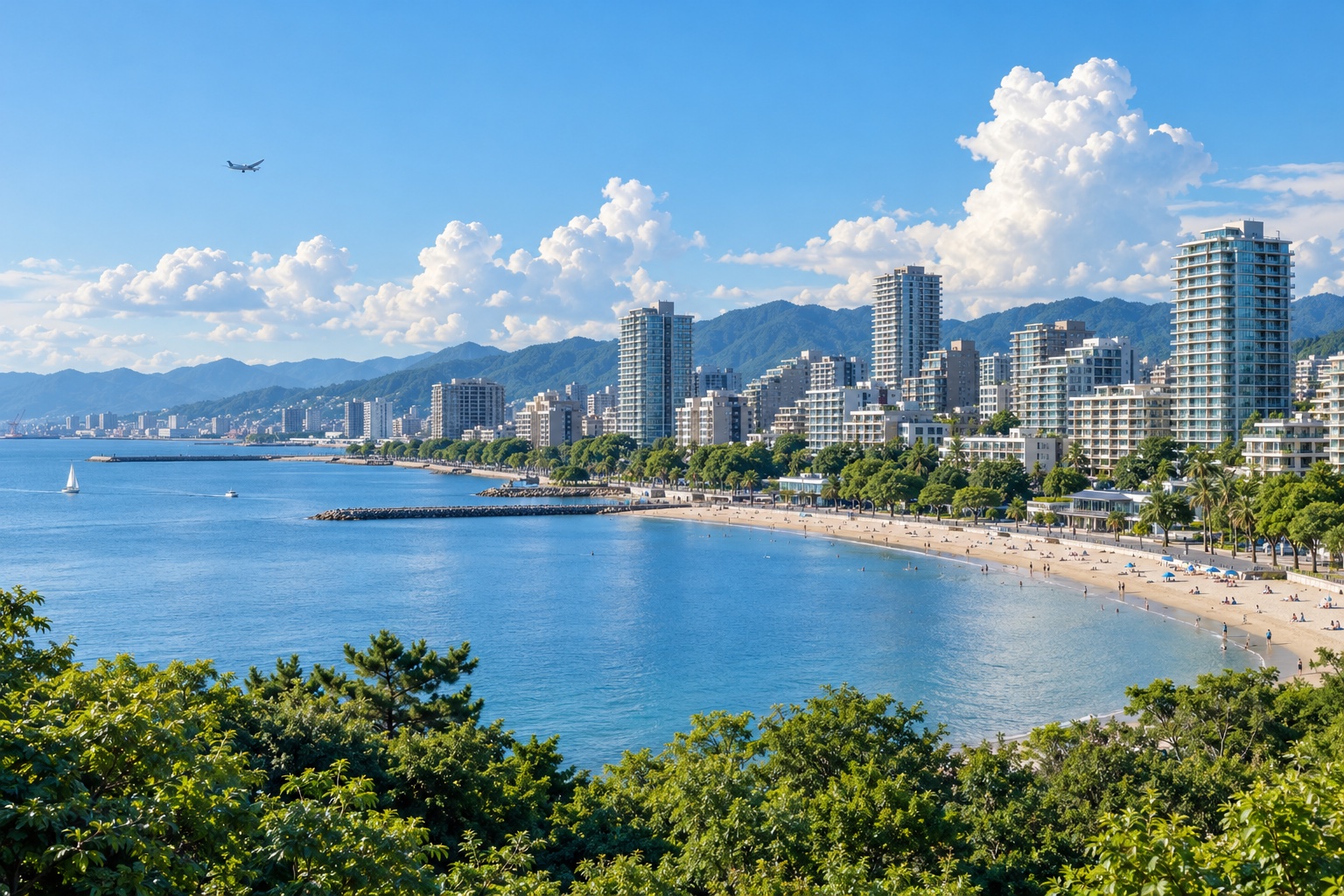
Looked at through transport, population, prices and risk, Fukuoka starts with three facts that public data can confirm: the airport is a few subway minutes from the city center, there are scheduled flights to Taiwan, and Fukuoka City's population is still growing. On prices, the 2026 official land price survey (as of January 1, 2026; change over the previous year) puts residential land in Fukuoka City at +7.0%, between Tokyo's 23 wards and Osaka City; that is a land price, so the cost of homes has to be read from separate statistics on resale transactions and new condominiums. Against that, active faults, liquefaction on reclaimed land, and noise and height limits around the airport all have to be checked property by property. This article sets out what the public data show as of August 4, 2026.
Flights, the airport subway and population: what the public data show
Scheduled flights to Taiwan. On the international route map in Fukuoka Prefecture's data book (as of October 1, 2025), Fukuoka Airport's international routes connect with 19 cities, and Taipei and Kaohsiung in Taiwan are among them.[1] Schedules can change with the season and with each airline's plans, so check the current timetable before you book.
From the airport into the city. According to the Fukuoka City Transportation Bureau, the subway Airport Line takes 5 minutes from Fukuoka Airport Station to Hakata Station and 11 minutes to Tenjin.[2] Fukuoka Airport Station is on the domestic terminal side, though. If you land at the international terminal, one way across is the airport's shuttle bus.[3]
Population. Preliminary figures from Japan's 2025 census put Fukuoka City's population at 1,663,892, up 3.2% from 2020. Among Japan's government-designated cities (large cities designated by government ordinance that take on more administrative responsibilities), Fukuoka City recorded the highest growth rate, as in the previous census.[4] The city's own projection (April 2024) also expects the total population to peak at about 1.7 million people around 2040 and decline after that.[5]
Where things are in Fukuoka City: Tenjin, Hakata, Momochi and the reclaimed islands
Fukuoka City is divided into 7 wards: Higashi, Hakata, Chuo, Minami, Jonan, Sawara and Nishi.[6] The place names you will hear most often sort out roughly as follows.
Tenjin (Chuo Ward): the commercial center, being rebuilt block by block. In February 2015 Fukuoka City launched "Tenjin Big Bang", covering an area with a radius of about 500 m (about 80 ha) around the Tenjin intersection. In parts of the area, height limits under the Civil Aeronautics Act have been relaxed through special approvals under the National Strategic Special Zone system; separately, the city grants floor-area-ratio bonuses to rebuilding projects it certifies. The general certification for the bonus covers buildings that take infectious-disease countermeasures and are scheduled for completion by December 31, 2026; for phased rebuilding across several blocks that meets specific conditions, the deadline is decided case by case.[7] Completion dates of individual projects can also be revised. If you look at a unit near Tenjin, whether a nearby building is being rebuilt or is due to be rebuilt can affect the view and the surroundings while work is under way.
Because Fukuoka Airport is so close to the city, buildings around it are subject to height restrictions under Article 49 of the Civil Aeronautics Act.[8] The height limits in parts of Tenjin were relaxed through the special-zone approvals described above.
Hakata (Hakata Ward): around Hakata Station. A similar program around the station, "Hakata Connected", started in 2019. It covers a radius of about 500 m from Hakata Station (about 80 ha) and uses relaxations of the floor-area ratio and other rules to encourage owners to rebuild into highly earthquake-resistant buildings. According to the city, 30 buildings had been completed as of the end of March 2026. The general certification for its floor-area-ratio bonus covers buildings scheduled for completion by December 31, 2028 that meet the conditions.[9]
Seaside Momochi (Momochihama and Jigyohama): reclaimed land spanning Sawara and Chuo wards. Seaside Momochi is land reclaimed from the sea starting in 1982, and it hosted the Asia-Pacific Exposition in 1989. It spans Jigyohama in Chuo Ward and Momochihama in Sawara Ward.[10] Nishijin, a name you will often hear alongside Momochi, has its subway station in Sawara Ward.[6]
Island City (Higashi Ward): reclaimed land in Hakata Bay. Reclamation began in 1994; as of October 2025, about 99.8% of the total 401.3 ha had been filled in.[11]
Fukuoka property prices: reading the public statistics
The resale and new-build figures below are for individual units in condominium buildings (what Japan calls mansion), not whole-building sales; detached houses and whole buildings need different data. Before calling Fukuoka "cheap" or "rising", be clear about what each number measures.
Land prices. The 2026 official land price survey (as of January 1, 2026; change over the previous year), published by the Ministry of Land, Infrastructure, Transport and Tourism (MLIT) on March 17, 2026, gives these averages and annual changes for residential land.[12]
| Area | Average residential land price (yen per m²) | Annual change |
|---|---|---|
| Fukuoka City | 258,100 | +7.0% (previous year: +9.0%) |
| Tokyo's 23 wards | 856,400 | +9.0% |
| Osaka City | 300,900 | +6.5% |
The average price is a simple average of the survey points, so it depends on which points are in the mix and is only a rough guide. The annual change is the average of the changes at points surveyed in both years, which shows how the same locations moved over the year, but the mix of locations still matters when you compare cities. Fukuoka Prefecture's own summary adds that rising construction costs, rising land prices and higher mortgage interest rates have slowed sales of detached houses and condominiums in some areas, and that land price rises have slowed as a result.[13]
What resale condominiums sold for. West Japan REINS figures for the April–June quarter of 2026 (calculated as 2-quarter moving averages) show 981 resale condominium transactions in Fukuoka Prefecture (the count is also a moving average), at an average of ¥436,000 per m² (+11.8% year on year) and an average price of ¥29.38 million (+11.9%), with an average exclusive area of 67.4 m² and an average building age of 27.0 years. Both the price per m² and the price have been above the same quarter of the previous year for 5 consecutive quarters.[14] These are past transactions, not a forecast, and they cover the whole of Fukuoka Prefecture rather than Fukuoka City alone. Resale transactions in Tokyo and Osaka are compiled by other organizations, so this article does not put them side by side.
What new condominiums are launched at. According to the Real Estate Economic Institute, the average launch price of new condominiums in Fukuoka City in 2025 was ¥53.05 million, down 5.2% from ¥55.98 million in 2024. This is an asking price at launch, not a transaction price, and Fukuoka City's figure includes units sold for investment.[15] Because the average moves with the mix of units launched each year, it does not mean the same unit became 5.2% cheaper.
Japanese listings give floor area in square meters, and for a condominium that is the unit's exclusive area, which, unlike the Taiwanese title-deed area (權狀坪數), does not include a share of common areas; even after converting to the same unit of measure, you need to check what each figure includes before comparing them.[16]
Local conditions to check in Fukuoka
The points below are local conditions worth special attention when you look at property in Fukuoka; most can be looked up for an individual property.
- Earthquakes and faults. The Kego fault zone runs through Fukuoka City, its southeastern section passing through Chuo and Minami wards among others. Its northwestern section last moved in the earthquake off the west coast of Fukuoka Prefecture on March 20, 2005 (magnitude 7.0). For the southeastern section, the magnitude is estimated at about 7.2 and the probability of an earthquake within 30 years at 0.3% to 6% (as of January 1, 2026); the government's evaluation places it in rank "S*", where S means the upper end of the probability range is 3% or more within 30 years, rated "high".[17] Check the building's seismic design and its maintenance records.
- Hazard maps. On Fukuoka City's integrated hazard map, you choose the types of hazard and enter an address to see flooding, landslides, storm surge, how strongly the ground shakes in an earthquake, tsunami and other risks layered together.[18]
- Liquefaction on reclaimed land. If the property is on reclaimed land such as Seaside Momochi or Island City, look at Fukuoka Prefecture's liquefaction forecast. The prefecture's earthquake assessment includes a liquefaction forecast, and its disaster-prevention app, "Fukuoka Bōsai Navi Mamoru-kun", maps the risk of liquefaction in 4 levels.[19] Check it for the property's exact location.
- Airport noise and height limits. Aircraft noise countermeasure zones are designated around Fukuoka Airport (the Type 1 zone covers Lden 62 dB and above; Lden is a day-long average noise measure that gives extra weight to evening and night-time noise).[20] Check whether the property is inside a zone, and how the height limits shape what can be built around it later.
- Rebuilding nearby. Redevelopment around Tenjin and Hakata is still going on. Ask whether any work is planned near the property and how it could affect the view, sunlight and noise.[7][9]
- Selling later. Ask the agent for recent transactions of similar properties in the same area, and roughly how long they took from listing to sale.
Sending money, tax, whether the unit can realistically be rented out, and the paperwork you would handle from Taiwan all depend on your tax residency, how the deal is structured, the property's use and the building's management rules, among other things. Before making an offer, put those questions to an agent and professionals in Japan together with the checks above.
When the picture changes
- If you are comparing with prices in Tokyo or Osaka, make sure you are comparing the same statistic. Land prices, resale prices and new-build launch prices do not always move in the same direction: Fukuoka City's average new-build launch price for 2025 fell from the previous year, while resale condominium prices in Fukuoka Prefecture for the April–June quarter of 2026 rose year on year. The two cover different areas and periods, so they should not be read as the same market moving in opposite directions.[14][15]
- If the property is on reclaimed land, in a flood risk area or inside a noise countermeasure zone, the risks of owning it and the terms when you sell may differ from those of a neighbor that looks equally well placed.
- If you plan to hold for the long term, factor in the city's population projection (a peak around 2040).[5] If you measure costs or sale proceeds in Taiwan dollars, the yen–Taiwan dollar exchange rate matters too.
- Redevelopment projects may finish later than planned, and noise, traffic and changes to the view during construction may last longer than expected.
Start with the area guide
To get a picture of Fukuoka Prefecture as a whole first, read our Fukuoka Prefecture area guide. Once you have the areas in mind, go through our current listings with the checklist above beside you.
When a Fukuoka unit makes your shortlist, weigh the ground it stands on, the fault zone and its position relative to the airport alongside the price and the exchange rate, and decide on all of them together.
Further reading: How to Choose Earthquake-Resistant Properties in Japan
Sources
- Fukuoka Prefecture: Data book on internationalization in Fukuoka Prefecture (November 2025), in Japanese
- Fukuoka City Transportation Bureau: Overview of the Transportation Bureau (July 2023), in Japanese
- Moji Customs: Fukuoka Airport guide map (May 2026), in Japanese
- Fukuoka City: Preliminary results of the 2025 census (May 2026), in Japanese
- Fukuoka City: Future population projection for Fukuoka City (April 2024), in Japanese
- Fukuoka City: Preliminary results of the 2025 census (population by ward), in Japanese; Fukuoka City Transportation Bureau: Tenjin Station, Hakata Station, Nishijin Station, in Japanese
- Fukuoka City: Tenjin Big Bang (updated February 26, 2026; archived copy), in Japanese; Fukuoka City: Press release (March 2021), in Japanese; Cabinet Office: Area-based special approval of Civil Aeronautics Act height limits in National Strategic Special Zones (November 2014), in Japanese; Fukuoka City: Tenjin Big Bang bonus certification guidelines (in force April 2025), in Japanese; Fukuoka City: Green bonus certification for the Tenjin 1-7 project (December 23, 2025), in Japanese
- MLIT Civil Aviation Bureau: Height restrictions around Fukuoka Airport (July 2019), in Japanese
- Fukuoka City: Hakata Connected (updated July 2026), in Japanese; Fukuoka City: Hakata Connected press release (January 2019), in Japanese
- Fukuoka City Museum: The Story of Momochihama (2005), in Japanese; Fukuoka City: City History Newsletter Fukuoka, issue 22, in Japanese
- Fukuoka City: City newsletter (October 15, 2025), in Japanese
- MLIT: 2026 official land price survey (March 17, 2026), in Japanese
- Fukuoka Prefecture: Overview of the 2026 official land price survey (March 2026), in Japanese
- West Japan REINS (Nishi-Nihon Fudōsan Ryūtsū Kikō): Quarterly summary report, April–June 2026 (July 27, 2026), in Japanese
- Real Estate Economic Institute: Nationwide new condominium market trends, 2025 (February 25, 2026), in Japanese
- National Federation of Real Estate Fair Trade Councils: Enforcement Rules of the Fair Competition Code for Real Estate Representations, Article 9, in Japanese; Ministry of the Interior notice (Executive Yuan website): Mandatory and prohibited provisions for standard-form contracts for the sale of existing homes (announced December 2025), in Chinese
- Headquarters for Earthquake Research Promotion: Long-term evaluation of the Kego fault zone (March 2007), in Japanese; same: List of long-term evaluation results (January 14, 2026), in Japanese
- Fukuoka City: City newsletter (June 1, 2025), in Japanese; Fukuoka City integrated hazard map, in Japanese
- Fukuoka Prefecture: Results of the earthquake disaster-prevention assessment survey (October 31, 2025), in Japanese; Fukuoka Prefecture: Fukuoka Bōsai Navi Mamoru-kun (October 31, 2025), in Japanese
- Fukuoka City: Coexistence between Fukuoka Airport and the community (updated May 2023), in Japanese
Related articles
 Topics
SORA Forms a Business Alliance with Baashir Advisory Group in Hong Kong
SORA Co., Ltd., the operator of realestatejapan.jp, has entered into a business alliance with Baashir…
October 6, 2026
 Guide
GuideBefore You Buy a ¥100 Million Condo in Japan: Documents to Request
Before you make an offer on a resale condominium in Japan, ask your agent for four documents: the management…
October 6, 2026
 Guide
GuideSecond Homes Near Tokyo: Karuizawa, Kamakura and Atami
Karuizawa, Kamakura and Atami are each about 45 to 70 minutes from Tokyo Station by train on official travel…
August 11, 2026