

Buying a Tokyo Tower Condo: What to Check Beyond the View
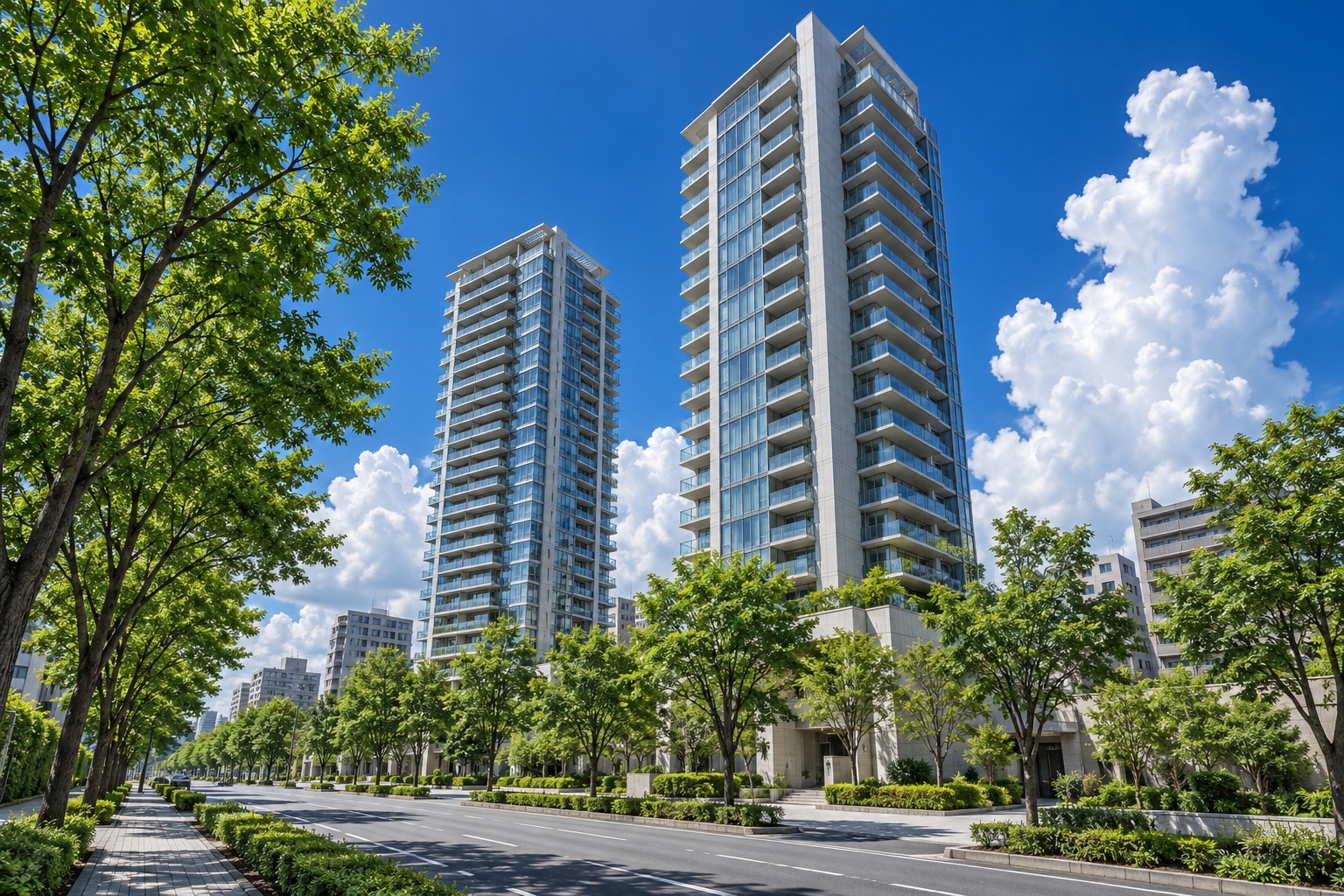
A "tower mansion" (tawā manshon, often shortened to tawaman) has no uniform legal definition in Japan and usually means a residential building of 20 or more floors; views, equipment and shared facilities are its main draws. In the long-period ground motion of a large earthquake, though, a tall building may sway strongly for a long time, upper floors tend to sway more, and the elevators may stop after a quake. So before you buy a Tokyo tower condo, use the building's documents to check its long-term repair plan and how its repair reserve fund (shūzen tsumitatekin, money set aside in advance for planned repairs to the common parts of the building) is built up, how the elevators and disaster preparedness are handled, and whether the view could be blocked in the future (information as of July 21, 2026).
What counts as a tower condo: no legal definition, usually 20 floors or more
A report by Kobe City states that there is no clear definition of a tower condominium, and for the purposes of that report covers "condominiums roughly 60 m or more in height or with 20 or more floors."[1] The Real Estate Economic Institute, a private research firm in Japan, also counts buildings of 20 or more floors as "super-high-rise condominiums" (chōkōsō manshon) in its statistics, and the repair reserve fund guidelines of the Ministry of Land, Infrastructure, Transport and Tourism (MLIT) likewise refer to "super-high-rise condominiums (generally 20 or more floors above ground)."[1]
Japanese law sets several thresholds related to building height. Two of the main ones concern structure and elevators:
- Over 60 m in height: the structure must be calculated using a method that captures the forces and deformations arising continuously in each part of the building, and must be certified by the Minister of Land, Infrastructure, Transport and Tourism (Building Standards Act, Article 20).[2]
- Over 31 m in height: in principle, an emergency elevator (hijōyō no shōkōki) must be installed (Building Standards Act, Article 34; exceptions apply).[3]
For readers from Taiwan, a comparison may help: in the high-rise chapter of Taiwan's Building Technical Regulations, a "high-rise building" is one with a height of 50 m or 16 or more floors.[4] The two countries draw the lines differently, so when you read a Japanese property listing, check the number of floors and the height together.
Upper floors or lower floors: what changes
Living high up or low down in the same tower condo can feel quite different. Here is what you can compare when choosing a floor (which side is better depends on how you live):
| Upper floors | Lower floors | |
|---|---|---|
| View and daylight | Less often blocked by nearby buildings (depends on orientation) | More easily blocked by surrounding buildings |
| Shaking in long-period ground motion | Swaying tends to be larger[5] | Relatively smaller within the same building (it still shakes) |
| When the elevators stop | Going up and down is hard; you rely on supplies stored at home[6] | Fewer stairs to climb (still depends on your health, and supplies are still needed) |
| Furniture measures | The Tokyo Fire Department urges residents of roughly the 10th floor and above to make sure to also take measures against furniture moving, in addition to preventing it from tipping over and falling[7] | Measures against tipping over and falling are still needed, and against moving depending on the furniture |
After the Great East Japan Earthquake, a questionnaire survey the Tokyo Fire Department carried out in Tokyo found that furniture tipped over, fell or moved for 47.2% of respondents on the 11th floor and above (36 respondents), compared with 16.8% on the 1st or 2nd floor. The higher the floor, the higher the share, and the department considers long-period ground motion to be one of the causes.[7] This was a single survey from 2011, not a prediction for any particular building.
When this conclusion may change. If someone in your household finds stairs difficult, or if being able to stay at home during a power outage matters a lot to you, you could prioritize lower floors, or properties with fewer stairs and power-outage measures that suit your family. If you are buying mainly as an investment and will rarely live there yourself, also check the quality of building management and rental demand separately with your agent.
Long-period ground motion: why upper floors sway more
What long-period ground motion is. According to the Japan Meteorological Agency (JMA), a large earthquake produces slow shaking with a long period, called long-period ground motion. Tall buildings have a long natural period, so they easily "resonate" with this kind of shaking; when they do, they sway strongly for a long time, and the upper floors tend to sway more than the lower floors.[5] Japanese government public information also explains that long-period ground motion can bring strong shaking even several hundred kilometers from the hypocenter, and that the slow swaying goes on for a long time.[5]
Long-period ground motion classes. The JMA divides shaking inside tall buildings into classes 1 to 4. Class 3 means "it is difficult to stand, unsecured furniture may move, and unstable items may fall over"; class 4 means "you cannot stand and can only move by crawling, most unsecured furniture moves, and some of it falls over." These are effects that may occur; the actual impact differs from building to building.[8] Since February 1, 2023, an Earthquake Early Warning (the "warning" level) is also issued when long-period ground motion of class 3 or higher is forecast.[9]
A past example. During the Great East Japan Earthquake in 2011, strong shaking was observed in tall buildings in Tokyo, with upper floors swaying more than lower floors. In Osaka, about 700 km from the hypocenter, people were trapped in a tall building when its elevators stopped.[10]
Older and newer buildings. In June 2016, MLIT announced countermeasures. In designated regions including Kanto, new buildings over 60 m in height certified by the minister on the basis of a performance evaluation (seinō hyōka) applied for on or after April 1, 2017, must be examined against long-period ground motion from a massive Nankai Trough earthquake. For existing super-high-rise buildings, where the newly set long-period ground motion exceeds what was assumed at the design stage, voluntary verification and, where needed, reinforcement are recommended; this is not mandatory.[11] If you are buying a resale tower condo, you can ask your agent to confirm when the performance evaluation was applied for, the structural type, and whether such an examination was made in the design.
Earthquake probability in Tokyo. The Japanese government's Headquarters for Earthquake Research Promotion estimates the probability of an earthquake of around magnitude (M) 7 associated with plate subduction occurring beneath the southern Kanto region within the next 30 years at around 70% (calculated with January 1, 2026 as the reference date). This is the probability of one occurring somewhere in the whole assessed area, not at a specific location.[12]
These sources describe tendencies in how buildings shake; they do not mean that any particular building is safe or unsafe. For an individual building's structure and countermeasures, rely on its design documents and the explanations given by its management.
Elevators after an earthquake and staying at home
Elevators stop automatically. Since September 28, 2009, newly installed elevators in Japan must be fitted with a "seismic control operation device" (jishinji kansei unten sōchi), which, on detecting shaking above a set level, automatically stops the car at a floor landing and opens the doors or lets passengers open them.[13] According to the Japan Elevator Association, an elevator that has stopped because of strong shaking (around seismic intensity (Japanese shindo) 4 or above) as a rule does not go back into service until a technician has inspected it, even if it is undamaged; after a major earthquake, getting elevators running again may take a long time.[14] Some elevators have a function that runs an automatic diagnosis and restarts them on a provisional basis.[15]
Tokyo's damage estimate. According to the damage estimate the Tokyo Metropolitan Government published in May 2022, there are about 166,000 elevators in Tokyo, and under the scenario of an "earthquake directly beneath southern central Tokyo" (on a winter evening, with a wind speed of 8 m/s), up to 22,426 elevators could stop in a way that may trap people (not counting elevators simply halted by the seismic control device). The same estimate notes that if a power outage stops the elevators, residents on the middle and upper floors of tower condos and similar buildings will find it hard to go between their homes and ground level, and without enough supplies stored at home it will be hard to keep living there.[6]
A power cut can also cut the water. The Tokyo Metropolitan Government points out that when a condo building loses power, the pumps that move water stop running, which can cut off the water supply. It recommends that residents check whether the owners' association (kanri kumiai, the body made up of the building's owners that runs the building) has a disaster-prevention manual and has stockpiled portable toilets and other supplies (at least 1 week's worth), and suggests placing disaster-supply storerooms on each floor or every few floors.[16]
Tokyo's registration system. Tokyo runs a registration system called "Tokyo Todomaru Mansion" (roughly, "condos you can stay in"). To be registered, a building must be earthquake-resistant and must have a disaster-prevention manual plus either a disaster drill at least 1 time a year or a system for checking on residents' safety (a building with emergency power that keeps the water supply and at least 1 elevator running during an outage can also register). From June 2026, registered buildings are rated from 1 to 5 stars: 1 star for these "soft" measures, and 1 more star for each "hard" measure, such as emergency power, preventing people being trapped in elevators, early elevator recovery and disaster stockpiles.[15] When you view a property, ask whether the building is registered and which grade it has.
Facilities and management: understanding the management fee and repair reserve fund
Some tower condos offer extensive shared facilities. That is part of their appeal, but it also affects future repair costs. When you buy a unit in a condominium in Japan, besides the purchase price you normally pay a management fee (kanrihi) and a repair reserve fund contribution every month.[17] This article does not discuss amounts; it explains how the system works and how to check it.
Why repair costs tend to be higher in tower condos. MLIT's "Guidelines on Repair Reserve Funds for Condominiums" (revised June 2024) give a separate reference range for buildings of 20 or more floors above ground. The reason is that repairing the exterior walls of a super-high-rise building requires special scaffolding or gondolas, and common areas make up a larger share of the building, so repair work tends to cost more; buildings with extensive shared facilities also tend to have higher repair costs. For buildings with a mechanical parking system, the repair costs of the parking equipment are added separately when estimating the repair reserve.[17]
The two main ways of building up the fund. There are two main methods for the repair reserve fund: the "equal accumulation method" (kintō tsumitate hōshiki), where owners save evenly according to the plan from the start, and the "graduated increase method" (dankai zōgaku tsumitate hōshiki), where contributions start low and are raised in steps. The guidelines consider the equal accumulation method preferable for building up the fund steadily over the long term; with the graduated method, there have been cases where owners could not agree when an increase was due, leaving the repair reserve fund short. The guidelines also point out that buyers of a newly built condo need to check which method the developer (bunjō gaisha) used to calculate the amount it presents.[18] For a resale property, look at the owners' association's long-term repair plan.
The long-term repair plan. MLIT's guidelines state that a long-term repair plan should cover a period of at least 30 years that includes at least 2 large-scale repairs, and that a survey and diagnosis should be carried out about every 5 years, with the plan and the repair reserve amount revised based on the results.[19]
What actually happens. According to MLIT's fiscal 2023 general survey of condominiums (Manshon Sōgō Chōsa), among owners' associations that have a long-term repair plan and collect repair reserve funds, 36.6% had current reserves below what the plan called for. Among owners' associations with a repair reserve fund system, 47.1% used the graduated increase method. Among single-building condos of 20 or more floors, 58.8% used the graduated increase method, but that figure is based on 51 responses and should be treated as a reference figure.[20]
When this conclusion may change. If the long-term repair plan has not been revised for many years, if the reserves are clearly below the plan, or if a large increase in the repair reserve fund is coming soon, that may be a reason to reconsider, however good the view.
Tower views: Tokyo Tower and Tokyo Skytree
If you are looking for an apartment with a view of Tokyo Tower or Tokyo Skytree, start by checking the direction. Tokyo Tower stands in Shibakoen, Minato City, and is 333 m tall; Tokyo Skytree stands in Oshiage, Sumida City, and is 634 m tall.[21] Units facing different directions in the same building have different views, so check on site which way the windows face.
Keep in mind that views change as the surrounding area is developed. According to Real Estate Economic Institute data from June 2026, as of the end of March 2026, 124 super-high-rise condo buildings with 50,935 units were scheduled for completion in Tokyo's 23 wards from 2026 onward (319 buildings and 107,408 units nationwide). These are planned figures, and the same material notes that because construction costs have risen, some projects have been significantly delayed or are being reconsidered.[22] A view you can enjoy today may be blocked by new buildings later.
The Tokyo Metropolitan Government's "Urban Planning Information Internet Service" lets you see decided plans, such as zoning districts (yōto chiiki) and planned city roads, on a map. However, the map shows approximate locations, and it may not tell you which buildings will go up in the future.[23] Ask your agent or the local ward office whether any redevelopment is planned nearby.
Reading Tokyo condo prices: the statistics do not separate floors
According to data published in July 2026 by the East Japan Real Estate Information Network (REINS), the average contract (closed) price for resale condos (manshon) in Tokyo's 23 wards in June 2026 was ¥1,311,500 per m², up 1.5% from the same month a year earlier. These are resale transaction data; newly built condos are not included in these statistics.[24]
The statistics are broken down by area and price band (with average floor area and building age also shown); they do not separate tower condos from other buildings, and they do not separate floors.[24] They are averages of past transactions and do not indicate future prices. Within the same building, transaction prices can also differ by floor, orientation and view. When you compare prices, ask your agent for transaction records for the same building or for properties with similar conditions.
What to confirm with your agent or a professional
- Documents: the important matters investigation report (jūyō jikō chōsa hōkokusho), the long-term repair plan, the management rules (kanri kiyaku), and the minutes of the owners' association's general meetings for recent years
- Long-term repair plan: the plan period, when it was last revised, and when the next large-scale repair is scheduled
- Repair reserve fund: whether it uses the equal or the graduated increase method, planned future increases, and the current balance
- Past changes to the management fee and repair reserve fund, and whether there are arrears for the building as a whole or for the unit itself
- The number of elevators, the emergency elevator, and whether the elevators have a seismic control operation device (older elevators may not have one), and whether they have an automatic diagnosis and provisional restart function
- Emergency power during a power outage (which equipment it supplies and for how long), and where the electrical equipment is located
- The owners' association's disaster-prevention manual, disaster-supply storerooms and stockpiles, and whether the building is registered as a "Tokyo Todomaru Mansion"
- When the performance evaluation was applied for, the structural type (earthquake-resistant, vibration-control or seismically isolated: taishin, seishin or menshin), and how long-period ground motion was considered in the design
- The results for the property's address on hazard maps for flooding, soil liquefaction and other disasters
- Urban planning and redevelopment plans in the surrounding area (and whether they could block the view)
- Check tax with a tax professional, loans with a lender and visas with a qualified specialist separately; this article does not cover them
Start by comparing current listings
To get a feel for what is on the market, you can browse current listings, which also include areas outside Tokyo, or read the Tokyo area guide for an overview of each ward. When a tower condo catches your eye, pass the checklist above to the agent and ask them to gather the documents before you decide.
Sources
- タワーマンションと地域社会との関わりのあり方に関する課題と対応策 最終報告書 (Final report on issues and responses concerning tower condominiums and local communities) (Kobe City, February 2025); 超高層マンション動向 2026 (Super-high-rise condominium trends 2026) (Real Estate Economic Institute, June 4, 2026); マンションの修繕積立金に関するガイドライン (Guidelines on repair reserve funds for condominiums) (MLIT, revised June 2024)
- 建築基準法 第20条 (Building Standards Act, Article 20) (e-Gov Law Search)
- 建築基準法 第34条 (Building Standards Act, Article 34) (e-Gov Law Search)
- 建築技術規則建築設計施工編 第227條 (Building Technical Regulations, Building Design and Construction, Article 227) (Laws & Regulations Database of Taiwan)
- 長周期地震動とは? (What is long-period ground motion?) (Japan Meteorological Agency); ビルの高層階を大きく揺らす「長周期地震動」緊急地震速報に追加! (Long-period ground motion, which shakes upper floors strongly, added to Earthquake Early Warnings) (Government of Japan Public Relations Online, November 25, 2022)
- 首都直下地震等による東京の被害想定 第3章 (Damage estimates for Tokyo from an earthquake directly beneath the capital, Chapter 3); 同 第5章 (same, Chapter 5) (Tokyo Metropolitan Disaster Prevention Council, May 25, 2022)
- 家具類の転倒・落下・移動防止対策ハンドブック(抜粋) (Handbook on preventing furniture from tipping, falling and moving, excerpt); 自宅の家具転対策 (Furniture safety measures at home) (Tokyo Fire Department)
- 長周期地震動階級および長周期地震動階級関連解説表について (Long-period ground motion classes and explanatory table) (Japan Meteorological Agency)
- 長周期地震動に対応した防災気象情報の強化について (Strengthening disaster-prevention weather information for long-period ground motion) (Japan Meteorological Agency, October 26, 2022); 緊急地震速報の発表基準への長周期地震動階級の追加 (Adding long-period ground motion classes to the Earthquake Early Warning criteria) (Japan Meteorological Agency)
- 長周期地震動による被害 (Damage caused by long-period ground motion) (Japan Meteorological Agency)
- 超高層建築物等における南海トラフ沿いの巨大地震による長周期地震動への対策について (Countermeasures for super-high-rise buildings against long-period ground motion from a massive Nankai Trough earthquake) (MLIT, June 24, 2016)
- 長期評価結果一覧 (List of long-term evaluation results) (Headquarters for Earthquake Research Promotion, January 14, 2026); 相模トラフ沿いの地震活動の長期評価(第二版) (Long-term evaluation of seismic activity along the Sagami Trough, 2nd edition) (same, April 2014)
- 建築基準法施行令 第129条の10 (Order for Enforcement of the Building Standards Act, Article 129-10) (e-Gov Law Search); エレベーターの安全に係る技術基準の見直しについて (Revision of technical standards for elevator safety) (MLIT)
- 昇降機の安全性について (About elevator safety); 大規模地震発生時のエレベーター早期復旧等に関するご協力のお願い (Request for cooperation on early elevator recovery after a major earthquake) (Japan Elevator Association)
- 東京とどまるマンション情報登録・閲覧制度基本方針 (Basic policy of the Tokyo Todomaru Mansion registration and viewing system) (Tokyo Metropolitan Government, effective June 5, 2026); 「東京とどまるマンション」登録表示制度の見直しを行います (Revision of the Tokyo Todomaru Mansion registration and labeling system) (Tokyo Metropolitan Government, June 5, 2026)
- マンション防災 (Disaster preparedness for condominiums) (Tokyo Metropolitan Government, January 2024)
- マンションの修繕積立金に関するガイドライン (Guidelines on repair reserve funds for condominiums) (MLIT, revised June 2024); 令和5年度マンション総合調査結果 (Results of the fiscal 2023 general survey of condominiums) (MLIT, June 21, 2024)
- マンションの修繕積立金に関するガイドライン (Guidelines on repair reserve funds for condominiums) (MLIT, revised June 2024)
- 長期修繕計画作成ガイドライン (Guidelines for preparing long-term repair plans) (MLIT, revised June 2024)
- 令和5年度マンション総合調査結果 (Results of the fiscal 2023 general survey of condominiums) (MLIT, June 21, 2024); 同 データ編(管理組合向け調査の結果) (same, data volume: survey of owners' associations)
- 東京タワー 会社概要 (Tokyo Tower company profile) (Tokyo Tower); 東京スカイツリーを知る (About Tokyo Skytree), アクセス (Access) (Tokyo Skytree)
- 超高層マンション動向 2026 (Super-high-rise condominium trends 2026) (Real Estate Economic Institute, June 4, 2026)
- 都市計画情報等インターネット提供サービス (Urban Planning Information Internet Service) (Bureau of Urban Development, Tokyo Metropolitan Government); 都市整備 (Urban development) (Tokyo Metropolitan Government)
- 月例速報 Market Watch サマリーレポート 2026年6月度 (Monthly Flash Report Market Watch summary, June 2026); data volume (REINS (East Japan Real Estate Information Network), July 10, 2026)
Related articles
 Topics
SORA Forms a Business Alliance with Baashir Advisory Group in Hong Kong
SORA Co., Ltd., the operator of realestatejapan.jp, has entered into a business alliance with Baashir…
October 6, 2026
 Guide
GuideBefore You Buy a ¥100 Million Condo in Japan: Documents to Request
Before you make an offer on a resale condominium in Japan, ask your agent for four documents: the management…
October 6, 2026
 Guide
GuideSecond Homes Near Tokyo: Karuizawa, Kamakura and Atami
Karuizawa, Kamakura and Atami are each about 45 to 70 minutes from Tokyo Station by train on official travel…
August 11, 2026