

Kyoto Property for Sale: Machiya, Condos and Where to Look
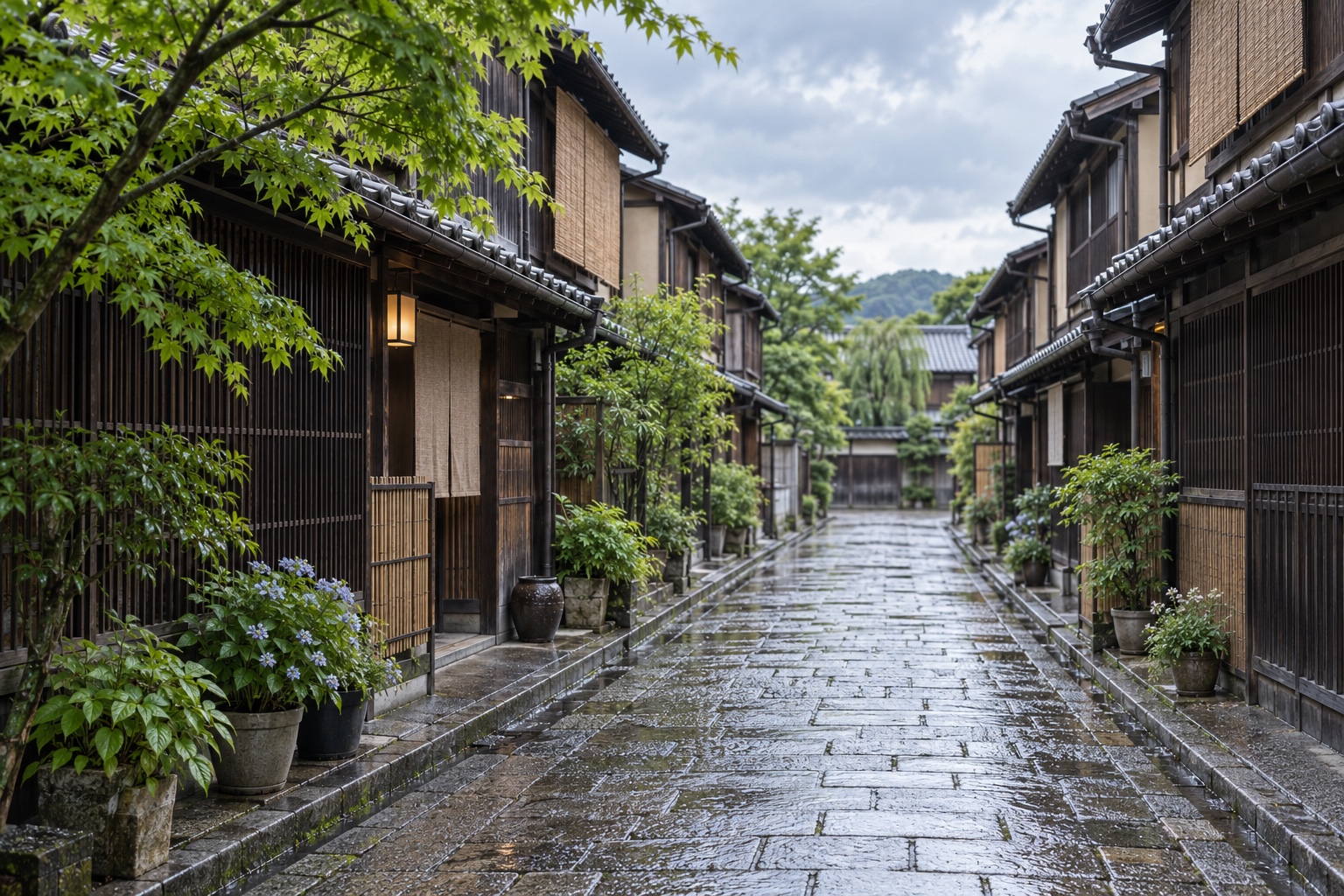
This guide compares two very different types of Kyoto property for sale: machiya, the old wooden townhouses of the historic city, and condominiums, which in the historic centre are subject to height limits the city lowered in 2007. Whether you start in Gion and Higashiyama, around Karasuma in Nakagyo, or in an area such as Okazaki depends on what the home is for — living in it, keeping it as a second home, or renting it out — and on how much checking of the building and the local rules you are ready to do; if you are looking at luxury property or homes in Gion, expect few comparable sales (see below). As of July 7, 2026. Tax, financing and visas are outside this guide, and the rules on rebuilding, townscape and lodging appear here as questions to check, not as answers.
Kyoto in brief
Kyoto City has 11 wards.[1] In the city's preliminary count for the 2025 census, taken on October 1, 2025, it had about 1.43 million residents, 2.2% fewer than in 2020.[2]
The city also draws very large numbers of visitors. By its own estimate, a record 62.79 million visitors came in 2025 (the count includes business and other non-commuting trips), and 8.09 million foreign guests stayed overnight, including foreign residents of Japan.[3] Crowding is something the city manages actively: the city and the Kyoto City Tourism Association publish live camera views, and for Golden Week 2026, from April 29 to May 6, they announced portable live cameras at two of the busiest points, the Kiyomizu-michi bus stop on the approach to Kiyomizu-dera and the taxi stand at Kyoto Station's Karasuma exit.[4]
If you will fly in and out, Kyoto Station is on the Tokaido Shinkansen, and JR's limited express Haruka runs from Kansai International Airport to Kyoto Station without a change of trains.[5]
Where to look for property in Kyoto
These sketches are not a ranking. Each one is a starting point for your own visits.
Gion and Higashiyama. Of the four districts in the city that the national government has selected for the preservation of traditional buildings, two are here: Gion Shinbashi, a teahouse district, and Sannenzaka, a temple-approach district.[6] South of Shijo Street, a district covering parts of Gion-machi Minamigawa and Komatsu-cho is a designated historic landscape area where teahouses and the businesses around them set the atmosphere; its own district plan restricts what buildings may be used for and, in part of the area, how tall they may be.[7] Homes on the most visited routes can expect crowds outside.
Nakagyo and Karasuma, the city centre. Kyoto City calls the blocks enclosed by Shijo, Kawaramachi, Oike and Karasuma streets its historic city centre, and it treats the Shijo Street frontage as one of Kyoto's principal shopping and business districts.[8] The city describes its centre as a mix of shopping streets, offices and traditional trades where streets of machiya survive, and it names the loss of machiya and the rise of tall condominium blocks as a problem for the townscape.[8] It suits buyers who want city life on foot.
Okazaki. Okazaki grew into a district of culture and events after Heian Shrine was founded and exhibition halls were built around it.[9] By March 2021, the city zoo, ROHM Theatre Kyoto and the Kyoto City KYOCERA Museum of Art had each been rebuilt or renovated.[9] Buyers who want museums close by can include it in their search.
The wider city. Kinki REINS, the network through which real estate agents in the region register listings and report sales, groups six wards as central Kyoto (Kita, Kamigyo, Nakagyo, Sakyo, Shimogyo and Higashiyama) and five as the rest of the city (Minami, Ukyo, Fushimi, Yamashina and Nishikyo).[10] In its latest monthly figures before this guide, average prices in the two groups were far apart (see below). If budget matters more to you than a central address, compare properties in the other five wards too.
Machiya or condominium?
Machiya. Kyoto City broadly defines a kyo-machiya as a wooden building built in or before 1950, the year Japan's Building Standards Act took effect, with a traditional structure and a form or design that grew out of city life.[11] A joint survey by the city and its partners in fiscal 2024, which followed up the machiya found in the prewar urban area and along old highways, recorded 5,566 machiya lost over about 8 years and estimated that 34,580 remained.[12] Since 2017 the city has had an ordinance on preserving machiya; designated machiya, whether designated individually or because they stand in a designated area, must be reported to the city before demolition, and the timing and exceptions are set out in the ordinance; owners of other machiya are also asked to notify the city in advance.[13] A free consultation service for questions on renovating, using and inheriting a machiya is listed on the city's machiya website and handled by the Kyoto Center for Community Collaboration.[14]
A machiya is part of the old city's fabric. A house built by 1950 is at least 75 years old, and its earthquake resistance, fire safety, insulation and upkeep all need a specialist's eye; what you may rebuild or change depends on the plot and the rules that apply to it. Ask your agent how long similar houses have taken to sell.
Condominiums. With a condominium (マンション, manshon) you own a unit, share the common parts with the other owners, and hold rights to the site; the owners' association, often through a management company, runs the shared parts of the building. In the historic centre, the city's height limits shape what can be built (see the next section). Before you buy, look at the building's management, its repair plan and reserve fund, and whether the building matches the rules that apply to its site today.
| Machiya | Condominium | |
|---|---|---|
| What you buy | The building and whatever land rights come with the sale | Your unit, a share of the common parts and rights to the site |
| Land owned or leased? | Check | Check |
| What to check first | Structure, fire safety, the plot and whether it can be rebuilt or altered | Management, repair plan and reserve fund |
| Upkeep | If you own the whole house, you arrange and pay for its upkeep | Owners share the common parts through the association; your unit is generally yours to maintain, and the building's rules set the details |
Kyoto's landscape rules, and what they mean for a buyer
Since September 1, 2007, Kyoto City has applied what it calls its New Landscape Policy, a city-wide review of the rules on building height, design and outdoor advertising.[15] It rests on five pillars: building height, building design, views and borrowed scenery, outdoor advertising, and historic streetscapes. When the policy began in 2007, the city lowered the height limits across almost the whole of the historic urban area.[15] Under its view ordinance the city has selected 49 views and borrowed landscapes for protection.[16]
None of this tells you what is allowed on a particular plot. It tells you which questions to ask:
- Which height and design rules apply to this plot or building today, and have they changed since 2007?
- If the building is older than these rules, does it exceed today's limits, and what would that mean if it were ever rebuilt?
- Do the rules affect changes to the exterior, such as windows, roofs, colours or signs?
- Does a protected view or borrowed landscape cross the site?
What prices look like
The figures below are averages for the properties each survey counts. They show the level, not the price of any home you will see.
Resale condominiums (contract prices). In January–March 2026, 482 resale condominium sales in Kyoto City were reported to Kinki REINS (only sales reported to it are counted). The average contract price was ¥34.55 million for an average of 61.54 m², in buildings about 28 years old.[17] Between areas the gap is wide. In May 2026, the latest month published before this guide, resale condominium sales reported to Kinki REINS (units of up to 350 m²) numbered 68 in the six central wards, at an average of ¥48.98 million, and 55 in the other five wards, at an average of ¥21.63 million.[10] The averages also reflect differences in unit size and building age, and figures from so few sales swing widely from one month to the next.
New condominiums (prices at release). The Real Estate Economic Institute recorded 2,615 new condominium units released in Kyoto City in 2025, at an average of ¥58.12 million, or ¥1.08 million per m².[18] These are the prices at which units were put on sale, not contracted prices, so they are not directly comparable with the resale figures.
Land. In the official land price publication for January 1, 2026, the average year-on-year change at the official residential benchmark sites was 3.6% for Kyoto City and 7.1% for Higashiyama Ward.[19] These are one year's changes at benchmark sites; they do not give the price of any particular house, and past rises are not a promise about the future.
Luxury property in Kyoto and Gion: few sales to compare
At the top of the market — a restored machiya near Gion, a large flat in a central building — averages tell you little. Kinki REINS recorded between 2 and 9 resale condominium sales a month in Higashiyama Ward over the 12 months to May 2026 (sales reported to it, units of up to 350 m²), covering the whole ward; houses, including machiya, are not in that figure.[10] With so few sales, ask your agent which recent deals for similar properties support the asking price, and how long similar homes took to sell.
Risks to weigh
- Earthquakes. Of the active fault zones assessed near the city, two are ranked A* by Japan's Earthquake Research Committee as of January 1, 2026: the central-southern part of the Hanaore fault zone and the Kyoto Nishiyama fault zone. The A rank covers a 0.1% to under 3% probability of an earthquake within 30 years, and the asterisk marks faults where the time since the last earthquake may have reached 0.7 or more of the average interval between earthquakes. Their own 30-year estimates run from almost 0% up to 0.6% (Hanaore) and up to 0.8% (Nishiyama). The committee adds that even for faults in its lowest-probability rank, the presence of an active fault itself shows that a large earthquake can occur in the area.[20] The city's ward-by-ward earthquake maps show the shaking expected from the fault that would do the most damage; for Sakyo and Nakagyo wards that is the Hanaore fault.[21] These are regional assessments, not a forecast for one building, so also check the building's age, structure and seismic work.
- Floods. Kyoto Prefecture's flood map for the Kamo and Takano rivers assumes, in its largest scenario, 736 mm of rain in 24 hours, and models flooding of about 7.7 m near where the Kamo meets the Katsura in Minami Ward.[22] Kyoto City announced new river-flood and inland-flood maps (for water that drains cannot carry away) in April 2026,[21] and the national hazard map portal lets you type in an address and see the risks it covers on one map.[23] Check every address before you view.
- Population. The government's population institute projects that Kyoto City will have about 1.24 million people in 2050.[24] Ask how quickly similar homes have sold in the area you are considering.
- Crowds. The visitor numbers that keep central Kyoto lively can also make daily life harder near the main sights.[3][4]
- Guest accommodation. Kyoto City has its own rules on private lodging (minpaku) on top of the national law.[25] Which permit or notification a lodging business would need, and whether a particular home can be used this way at all, is something to confirm before you buy, not after.
- Currency. If your income is in another currency, a change in the yen can raise or lower what the purchase, the upkeep and an eventual sale are worth when converted into your home currency.
Questions to put to your agent and specialists
- Is the house a machiya under the city's definition, and is it designated, individually or as part of a designated area, under the machiya ordinance? Ask your agent.
- Can the building be rebuilt, enlarged or altered on this plot, and does it meet today's rules? Ask your agent and an architect.
- What is the condition of the structure, roof and timber, and what would earthquake and fire upgrades involve? Ask an architect or building inspector.
- Which landscape rules apply to the plot, and which exterior changes need approval? Ask your agent and the city.
- If you are thinking of short stays or guest accommodation, which permit or notification would apply, and what do the city's rules and the building's own rules allow? Ask your agent and the city's public health centre (医療衛生センター), which handles lodging.
- For a condominium, what do the management rules say about renting out, renovation and pets, and how healthy is the repair reserve? Ask your agent for the documents.
- Where does the address sit on the earthquake and flood maps? Check it yourself and ask your agent.
You can also confirm that the agency (the brokerage firm) holds a real estate brokerage license in the Ministry of Land, Infrastructure, Transport and Tourism's online search, which covers firms licensed by the ministry and by each prefecture.[26]
When this advice changes
- You plan short stays or guest accommodation. The lodging rules and the building's rules come first; they can rule out a plan before price does. For ordinary long-term renting, start with the building's rules and the lease terms.
- You want to rebuild or remodel a machiya heavily. Find out what can be done on the plot before you make an offer.
- Work or school fixes your area. Start from that area and use this guide for the choice of property type.
- You will borrow. Talk to lenders before you shortlist.
- You want to avoid flood and fault risks. Let the hazard maps narrow your areas first.
Start your search
To see what is on the market now, browse homes for sale across Japan and narrow the results to Kyoto, or open our Kyoto prefecture guide for its main areas and stations. Bring the questions above to every viewing, whichever agent you use.
Sources
- Overview of Kyoto City: wards (京都市のあらまし 行政区), Kyoto City
- 2025 Census preliminary results for Kyoto City, Kyoto City (May 20, 2026); 2025 Census preliminary results, Statistics Bureau of Japan (May 29, 2026)
- Kyoto Tourism Survey 2025, Kyoto City (June 12, 2026)
- Crowding information for the Golden Week holidays, Kyoto City and Kyoto City Tourism Association (April 24, 2026)
- Kyoto Station information, Central Japan Railway Company; Access FAQ, Kansai Airports (archived May 20, 2026)
- List of Important Preservation Districts for Groups of Traditional Buildings, Agency for Cultural Affairs (as of August 15, 2024); Traditional building preservation districts, Kyoto City
- Gion-machi Minamigawa district plan, Kyoto City (April 2017)
- Briefing on the Shijo Street urban plan (refers to the historic city centre), Kyoto City (September 2011); Kyoto City urban planning master plan, chapter 11 (March 2013)
- Okazaki area revitalisation vision: ten-year review, Kyoto Okazaki council (published by Kyoto City) (March 2021); Okazaki area revitalisation vision (draft) (March 2011)
- Monthly report No. 162 (June 2026), Kinki REINS (June 2026)
- What is a kyo-machiya? Kyoto City (archived April 16, 2026)
- Survey of remaining kyo-machiya, fiscal 2024, Kyoto City (February 2025)
- Kyoto City Ordinance on the Preservation and Succession of Kyo-machiya (November 16, 2017); Machiya designation system, Kyoto City
- Machiya consultation, Kyoto City (archived April 20, 2026)
- New Landscape Policy, Kyoto City (archived April 16, 2026); Kyoto City landscape policy leaflet (2009)
- Kyoto City Landscape White Paper, fiscal 2025, chapter 2 (pp. 50–79), Kyoto City (April 2026)
- Quarterly market trends, January–March 2026, Kinki Real Estate Information Network System (Kinki REINS) (April 20, 2026)
- Kinki new condominium market, 2025 summary, Real Estate Economic Institute (January 26, 2026)
- 2026 official land prices: Kyoto Prefecture summary, Kyoto Prefecture (March 18, 2026)
- Summary of long-term evaluations of major active faults (as of January 1, 2026), Earthquake Research Committee (January 14, 2026)
- Earthquake hazard maps, Kyoto City; Kyoto City disaster information map and new hazard maps, Kyoto City (April 28, 2026)
- Kamo and Takano rivers flood inundation map, Kyoto Prefecture (June 2018)
- Hazard Map Portal Site, Ministry of Land, Infrastructure, Transport and Tourism and Geospatial Information Authority of Japan; Hazard Map Portal Site renewal, Geospatial Information Authority of Japan (May 30, 2023)
- Regional population projections for Japan (2023), National Institute of Population and Social Security Research (December 22, 2023)
- Private lodging business (minpaku), Kyoto City; For those who want to start minpaku, Kyoto City
- Search system for construction and real estate businesses, Ministry of Land, Infrastructure, Transport and Tourism
Related articles
 Topics
SORA Forms a Business Alliance with Baashir Advisory Group in Hong Kong
SORA Co., Ltd., the operator of realestatejapan.jp, has entered into a business alliance with Baashir…
October 6, 2026
 Guide
GuideBefore You Buy a ¥100 Million Condo in Japan: Documents to Request
Before you make an offer on a resale condominium in Japan, ask your agent for four documents: the management…
October 6, 2026
 Guide
GuideSecond Homes Near Tokyo: Karuizawa, Kamakura and Atami
Karuizawa, Kamakura and Atami are each about 45 to 70 minutes from Tokyo Station by train on official travel…
August 11, 2026