

Osaka Property for Sale: A Guide for Overseas Buyers
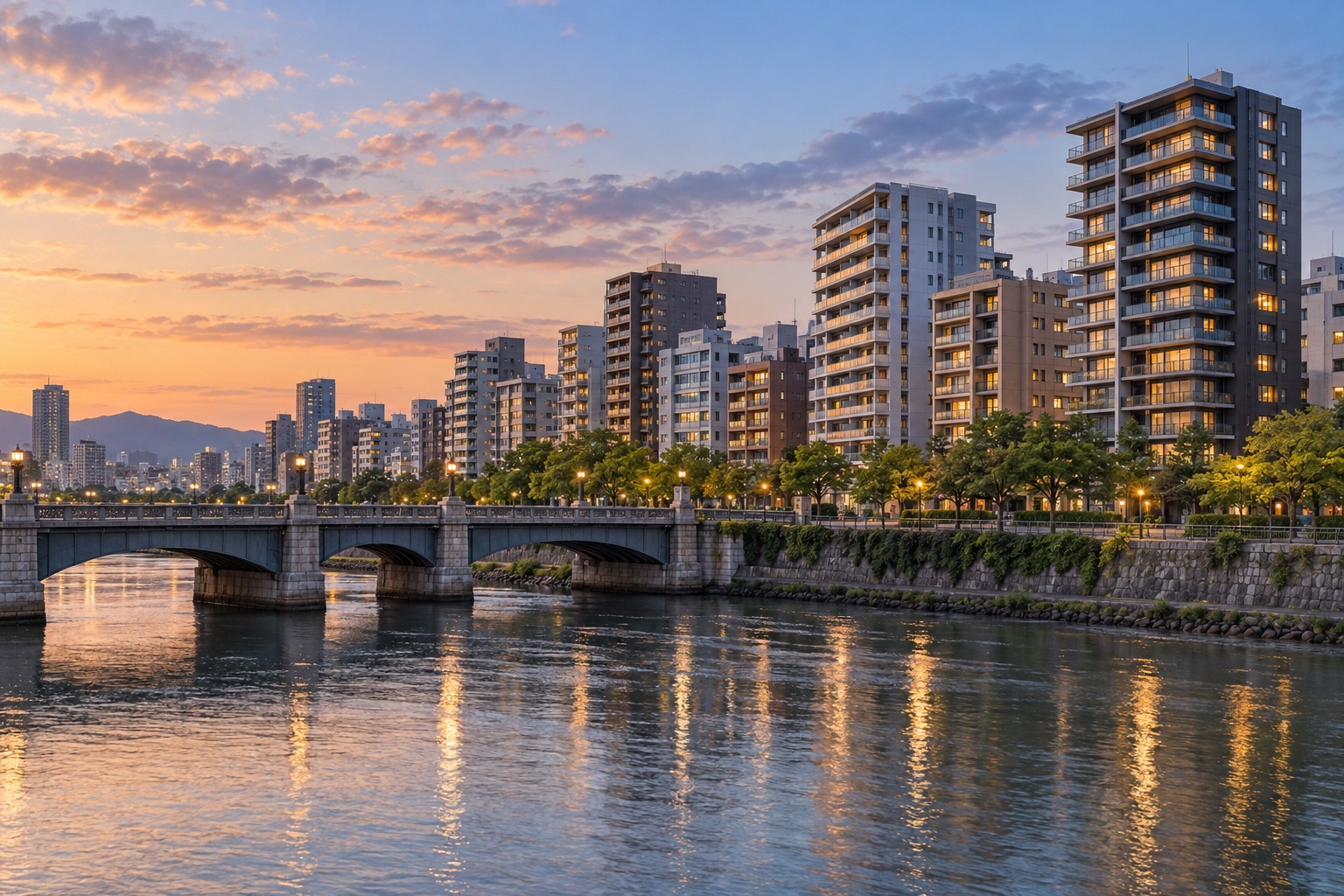
Osaka property for sale can range from apartments near the big rail terminals of Umeda and Namba to larger condominiums and houses in the northern suburbs, and whole apartment buildings for investors. If you want to buy property in Osaka from overseas, decide first what it is for — living in it, keeping it as a second home, or renting it out — and let that choose the area and the type; then work through a licensed agent who can send you documents and arrange viewings while you are abroad. This guide to Osaka real estate for foreign buyers, as of June 2, 2026, gives you the map; it does not cover tax, financing, visas or the legal rules on foreign ownership.
Osaka at a glance
"Osaka" can mean the city or the prefecture. Osaka City is divided into 24 wards[1] and had about 2.75 million residents in the 2020 census.[2] Osaka Prefecture, which includes the city and its suburbs, had about 8.76 million people in the prefecture's preliminary count of the 2025 census, 0.83% fewer than in 2020, while the number of households rose; Osaka City recorded the largest increase in number of residents of any municipality in the prefecture.[3]
For a buyer who will often fly in and out, access is part of the property. Shin-Osaka is the city's station on the Tokaido and Sanyo Shinkansen lines.[4] Nankai's limited express rapi:t links Namba with Kansai International Airport in as little as 34 minutes.[5]
The main kinds of area
This is a sketch of the kinds of area you will see in listings, not a ranking. Each district deserves a closer look than this guide gives it.
The big rail terminals. Osaka City chose Umeda (around Osaka Station), Namba and Tennoji-Abeno for its first barrier-free transport plans in 2003 as the three districts with the most rail passengers.[6] Namba is the centre of the district called Minami, with many shopping streets and department stores and visitors from across Japan and abroad.[7] Apartments close to these hubs offer convenience; check the foot traffic and noise around the building itself.
The central wards around them. Between and around the terminals you will find condominiums of many ages and sizes. Compare the building, the walk to a station and the floor plan, not only the district name.
The bay and the rivers. Osaka City describes itself as surrounded by rivers and the sea, with wide areas of flat, low-lying land that make it very vulnerable to flooding.[8] For any address near the bay or a river, read the flood and tsunami maps before anything else (see the risks below). You will also hear about Yumeshima, an area of reclaimed land in the Port of Osaka[9] that hosted Expo 2025 from April 13, 2025 to October 13, 2025[10] and is the site of an integrated resort (IR) plan approved by the national government on April 14, 2023, which Osaka Prefecture is working to open around autumn 2030. The approval came with conditions, including continued monitoring of ground subsidence on the site and careful study so that measures against liquefaction do not fall short.[11] These are events and plans, not a promise about prices in nearby areas.
The northern suburbs. North of the Yodo River, outside the city, lie cities such as Toyonaka, Suita and Minoh. In January–March 2026, resale condos sold in the northern part of the prefecture as a whole were larger and cheaper on average than in Osaka City, and also older: about 30 years on average against about 25 in the city (see the figures below).[12] Buyers who want more space can include these cities in their comparison.
Types of property you will see
- Condominiums (マンション, manshon). You usually own a unit and share the costs of the building through the owners' association, so the building's management and repair plans matter as much as the unit.
- New-build and resale condos. New units are sold by the developer or its sales agent. With a resale unit you can see the actual building and ask for whatever management and repair records are available before you buy.
- Detached houses (一戸建て, ikkodate). Usually you buy the land and the house, but some houses stand on leased land (借地権, shakuchiken), so ask which it is. The plot, the road access and the condition and history of the house all need their own checks.
- Whole buildings (一棟, ittō). Apartment buildings sold as a whole. You take on the management and repair of the entire building and, if it is let, the existing tenancies, so they deserve a separate study.
What prices look like
Two sources give a sense of the level. They are averages for the properties each survey covers, not a price for any particular apartment.
Resale condos (contracted prices). In January–March 2026, 1,492 resale condominium sales in Osaka City were reported to Kinki REINS, the listing network used by real estate agents in the region (only sales reported to it are counted). The average contract price was ¥43.44 million for an average of 60.07 m², in buildings about 25 years old on average. In the northern part of the prefecture, the average was ¥34.03 million for 74.03 m², in buildings about 30 years old.[12] These are prices in sales contracts, not asking prices, and quarterly averages move with the mix of units sold.
New condos (prices at release). In 2025, developers released 5,370 new condominium units in Osaka City, at an average price of ¥50.23 million, or about ¥1.16 million per m².[13] These are the prices at which units were offered for sale, not contracted prices, so they are not directly comparable with the resale figures above. The research firm says the Kinki-wide average price fell from the previous year because more investment-type units were released.[13] An average that mixes investment units with family homes can mislead, so compare like with like.
Risks to weigh before you buy
- Earthquakes. Japan's Earthquake Research Committee puts the probability of a magnitude 8 to 9 Nankai Trough earthquake within 30 years at "60% to about 90% or more" under one model and 20–50% under another, as of January 1, 2026. Neither model is ranked above the other, but for disaster preparedness the government's earthquake research headquarters has asked people to act with the higher figure in mind.[14] This is a regional probability, not a forecast for one building. For any one purchase, also check the building's age, the seismic design rules in force when it was approved, the ground, and the owners' preparations.
- Floods, storm surges and tsunamis. Osaka City publishes ward-by-ward maps of expected flooding from rivers, drains, storm surges and tsunamis,[8] and the national hazard map portal lets you enter an address and overlay the risks it covers on a map.[15] Each map is based on set scenarios, and the city notes that areas outside the mapped zones can still flood and that actual depths can differ.[8] Check every address before you view, not after you make an offer.
- Population. The government's population institute projects that Osaka Prefecture will fall from about 8.84 million people in 2020 to about 7.26 million in 2050.[16] That projection is for the prefecture as a whole, and population alone does not decide demand: the number of households rose in the 2025 count.[3] For the area you are looking at, also ask about vacancies, new supply and how long similar properties take to sell.
- Older buildings and resale. The resale average above comes from buildings about 25 years old on average.[12] Check the repair plan, the reserve fund and the seismic design rules before you weigh the lower price of an older building, and think about who will buy the property from you later.
- Currency. If you earn in another currency, a move in the yen can change what the purchase, the running costs and the eventual sale are worth to you, in either direction.
How to buy property in Osaka from overseas
The steps below are an outline. The exact order, documents and timing depend on the property and the deal, so confirm each one with your agent.
- Decide the purpose and budget. Living in the property, keeping it as a second home, or renting it out lead to different areas and property types.
- Browse listings and shortlist. Narrow down by area, type and size before you contact anyone.
- Check the agent. Ask for the brokerage's real estate license number and look it up in the Ministry of Land, Infrastructure, Transport and Tourism's public search system, which covers agents licensed by the ministry and by each prefecture.[17]
- View remotely, then in person if you can. Ask whether the agent can arrange a video viewing, and ask for the floor plan and the building's management and repair documents in writing.
- Make an offer and contract. Ask your agent when you will receive the explanation of important matters and the contract, and in which language; have anything you do not understand translated and checked.
- Settle and arrange management. Plan who will look after the property, pay the monthly charges and deal with the building while you are abroad.
Questions to check with your agent and other professionals
These depend on your situation and on legal and tax rules, so get the answers from the right professional rather than from this guide:
- What rules apply to you as a foreign buyer, and are any reports or notifications needed before or after the purchase? Ask your agent and a lawyer or judicial scrivener.
- Which taxes and costs apply when you buy, while you own, and when you sell? Ask a tax accountant.
- Can you get a loan, from which lender, and on what terms? Ask lenders directly.
- What do the building's rules say about renting the unit out or about short-term rental? Ask your agent for the exact clauses.
- Is the address inside an expected flood or tsunami area, and what does the hazard map show? Check it yourself and ask your agent.
- Does owning property in Japan have any bearing on a visa or residence application you are considering? Ask an immigration specialist; do not assume it does.
What would change this picture
- Your area is already fixed. If a school, an office or family decides where you live, start from that area and use this guide only for the property type.
- You plan to rent the property out. Check the building's rules and the regulations for the kind of rental you have in mind, ordinary letting or short stays; they can rule out a plan before price does.
- You need a loan. Find out whether and how you can borrow before you shortlist properties.
- The address sits in an expected flood area. Decide whether you accept that risk; if you go ahead, it should change which floors, buildings and insurance you look at.
See current listings
The checks above apply with any agent. You can browse listings across Japan and filter by Osaka, or read our Osaka prefecture guide for an overview of areas and stations.
Sources
- Flood hazard maps (水害ハザードマップ), Osaka City Crisis Management Office
- 2020 Census results for Osaka City, Osaka City Planning and Coordination Bureau
- Population and households in the 2025 Census (preliminary), Osaka Prefecture (May 22, 2026)
- Shin-Osaka Station area urban regeneration plan outline, Shin-Osaka Station Area Council (published by Osaka Prefecture) (March 2020)
- rapi:t 30th anniversary news release, Nankai Electric Railway (August 2, 2024)
- Namba barrier-free transport plan, Osaka City (April 2025)
- Namba barrier-free transport plan, district overview, Osaka City (April 2025)
- Flood hazard maps (水害ハザードマップ), Osaka City Crisis Management Office
- Yumeshima Phase 2 master plan, Ver. 2.0 (draft), Osaka Prefecture and Osaka City (June 2025)
- Expo 2025 Osaka, Kansai: overview, Japan Association for the 2025 World Exposition
- Approval of the Osaka Yumeshima IR area development plan, Japan Tourism Agency (April 14, 2023) and its attached conditions; Start of Osaka IR construction, Osaka Prefecture (April 24, 2025)
- Quarterly market trends, January–March 2026, Kinki Real Estate Information Network System (Kinki REINS) (April 20, 2026)
- Kinki new condominium market, 2025 summary, Real Estate Economic Institute (January 26, 2026)
- Updated long-term earthquake probabilities (as of January 1, 2026), Earthquake Research Committee (January 14, 2026); Partial revision of the long-term evaluation of seismic activity in the Nankai Trough, Headquarters for Earthquake Research Promotion (page updated March 5, 2026)
- Hazard Map Portal Site, Ministry of Land, Infrastructure, Transport and Tourism and Geospatial Information Authority of Japan; Hazard Map Portal Site renewal, Geospatial Information Authority of Japan (May 30, 2023)
- Regional population projections for Japan (2023), National Institute of Population and Social Security Research (December 22, 2023)
- Search system for construction and real estate businesses, Ministry of Land, Infrastructure, Transport and Tourism
Related articles
 Topics
SORA Forms a Business Alliance with Baashir Advisory Group in Hong Kong
SORA Co., Ltd., the operator of realestatejapan.jp, has entered into a business alliance with Baashir…
October 6, 2026
 Guide
GuideBefore You Buy a ¥100 Million Condo in Japan: Documents to Request
Before you make an offer on a resale condominium in Japan, ask your agent for four documents: the management…
October 6, 2026
 Guide
GuideSecond Homes Near Tokyo: Karuizawa, Kamakura and Atami
Karuizawa, Kamakura and Atami are each about 45 to 70 minutes from Tokyo Station by train on official travel…
August 11, 2026